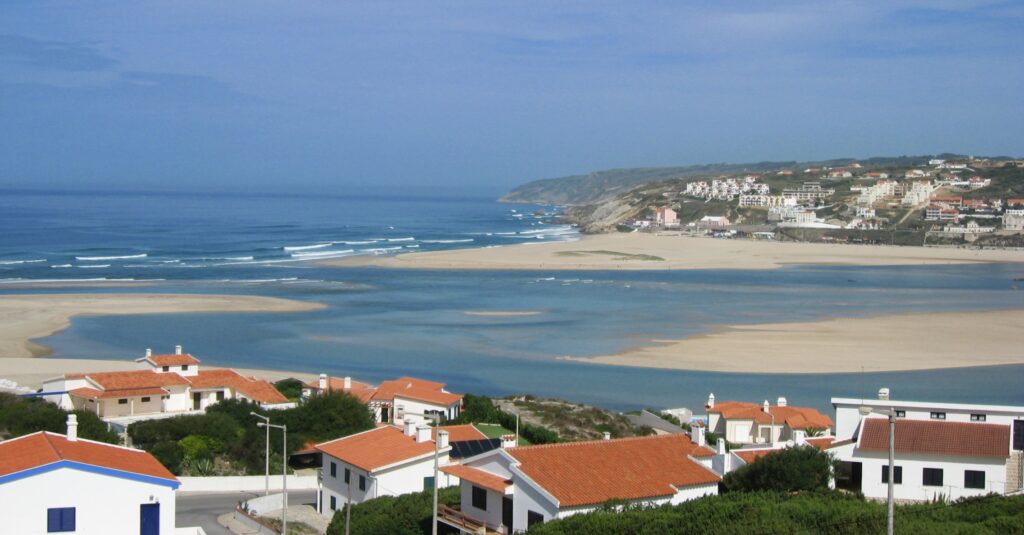
The PSD parliamentary group recommended to the Government the creation of the Óbidos Lagoon Observatory, managed by the municipalities of Caldas da Rainha and Óbidos, to continuously monitor the operation of Portugal’s largest coastal lagoon.
In a draft resolution presented in the Assembly of the Republic (AR), the PSD argues that the valorization of Óbidos Lagoon, in the Leiria district, “should be understood as a public policy priority,” recommending the creation of an observatory that would function as “a structure for monitoring, institutional coordination, public information, and technical-scientific oversight.”
For the PSD parliamentary group, the lagoon, located in the municipalities of Caldas da Rainha and Óbidos, constitutes “one of the most relevant coastal lagoon systems in the country,” being Portugal’s largest coastal lagoon, covering about 1,040 hectares.
“Because of its singular configuration, the diversity of habitats it shelters, and its dynamic connection to the Atlantic Ocean,” it assumes “a critical ecological function in the environmental balance of the Oeste region,” reads the draft resolution in which the PSD argues that Óbidos Lagoon requires “a permanent approach to protection, valorization and monitoring.”
Considering fishing and shellfish gathering, nautical activities and nature tourism associated with the lagoon, the Social Democrats regard it as “a true anchor of local and regional development, with direct impact on the economy, employment, tourist attractiveness and the quality of life of the populations.”
Subject to vulnerabilities such as “progressive silting, instability of the connection to the sea, deterioration of water quality in certain contexts and the need for regular maintenance interventions, dredging and requalification,” the lagoon has, since 2015, a Commission for Monitoring Interventions under the Environmental Management Plan, which brings together the various entities responsible for this territory overseen by the Portuguese Environment Agency (APA).
However, in the PSD’s view, “it is essential to move from a predominantly reactive logic centered on ad hoc interventions to a logic of integrated governance, based on permanent technical monitoring, information sharing among entities, regular production of indicators, and public transparency,” which justifies the creation of a local observatory.
The PSD argues that this structure should be led by the two municipalities and include the participation of the parishes directly involved (Foz do Arelho, Nadadouro, Vau, and the Union of Parishes of Santa Maria, São Pedro and Sobral da Lagoa) and central government entities: APA, the Portuguese Institute for the Sea and the Atmosphere (IPMA), the Lisbon and Tagus Valley Region Coordination and Development Commission (CCDR-LVT), and the maritime authority.
The document defines the observatory’s mission as “ensuring an integrated and continuous view of the functioning of the lagoon ecosystem, supporting risk prevention, environmental protection, and sustainable economic valorization,” and proposes that the municipalities ensure human resources and commit to contracting an annual “bank” of hours for lagoon dredging services.
APA will provide technical support on water resources, hydraulic interventions, water quality, and environmental framing; IPMA will supply information on monitoring of bivalve mollusks, phytoplankton, and related laboratory parameters; the maritime authority will coordinate on safety, navigation, and maritime-port uses; and the other entities will provide technical and institutional cooperation within their respective areas of competence.
The observatory, which the PSD recommends be funded by the State Budget and by the European Union’s Territorial Cohesion funds, should also promote research around the lagoon.