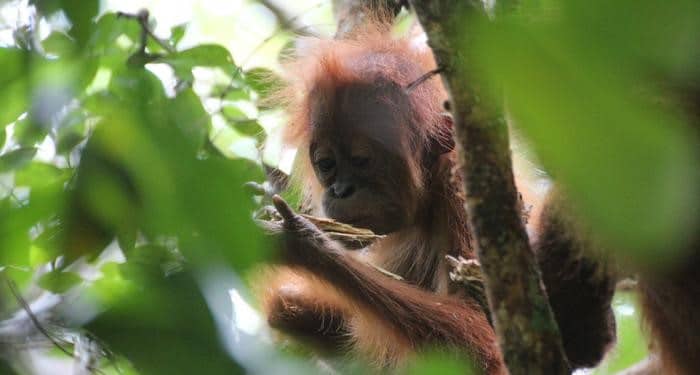
Orangutans face problems similar to humans when they do not sleep enough, and they have a very similar strategy—taking a nap—according to a study.
“Moving through the tree canopy, foraging for food, solving problems, socializing — all of these are exhausting and cognitively demanding tasks”, emphasized Alison Ashbury, the study’s first author, who brought together researchers from the Max Planck Institute for Animal Behavior (MPI-AB) and the University of Konstanz (both in Germany), in collaboration with scientists from the National University of Indonesia.
“When an orangutan does not get enough sleep, it does what any sleep-deprived human would do: crawl into bed, lie down and take a nap,” added the researcher, about the findings published in the journal “Current Biology”.
The research team worked in the Indonesian tropical forest to examine the sleep patterns of wild adult orangutans, which had never before been studied specifically in terms of their ability to solve sleep-related problems.
The work opened a new perspective on understanding how sleep evolved in the great apes and in human ancestors.
The scientists collected data on 53 adult orangutans over 14 years at the Suaq Balimbing Monitoring Station in Sumatra, recording a total of 455 days and nights of orangutan behavior.
But tracking sleep in the wild posed logistical challenges for human observers. Like humans, wild orangutans sleep in nests, known as “nests”, which provide a safe place to rest.
Every night, an adult orangutan settles high in the canopy of the tropical forest. There, it spends about ten minutes constructing a nest: folding, breaking and weaving tree branches to create a solid platform, with a bed of leaves and a cushion for greater comfort.
Mothers share the nests with their breastfeeding offspring, but, save for rare exceptions, adult orangutans sleep alone. At dawn, they leave their nests to start the day.
“From our terrestrial perspective, we generally cannot see the orangutans in their nightly nests, but we can hear them moving and settling. Then, everything goes quiet, and the opposite happens in the morning,” explained Caroline Schuppli, the study’s principal author and group leader at MPI-AB.
It was this intermediate period of silence that the researchers called the “sleep period” and used as the indicator for sleep. They found that the orangutans’ sleep periods lasted, on average, nearly 13 hours.
The researchers also discovered that several factors were associated with shorter nighttime sleep periods: sleeping near other orangutans, cooler nighttime temperatures and longer movements.
To understand how orangutans recover from sleep loss, the team analyzed how the duration of naps varied with the previous night’s rest.
They found a clear compensatory effect, as the orangutans’ naps were longer on the days following shorter nighttime sleep periods and, when they did sleep, they slept 5 to 10 minutes longer for each hour less sleep the night before.
“For humans, even a short nap can have significant restorative effects,” recalled co-author Meg Crofoot, director of MPI-AB and a professor at the University of Konstanz.
The daytime nests are crucial for this strategy. Compared with orangutans from many other populations, the Suaq orangutans build nests more frequently during the day.
These nests are simpler and quicker to construct than the nighttime nests, normally taking less than two minutes, yet they still provide a stable and safe place to doze.