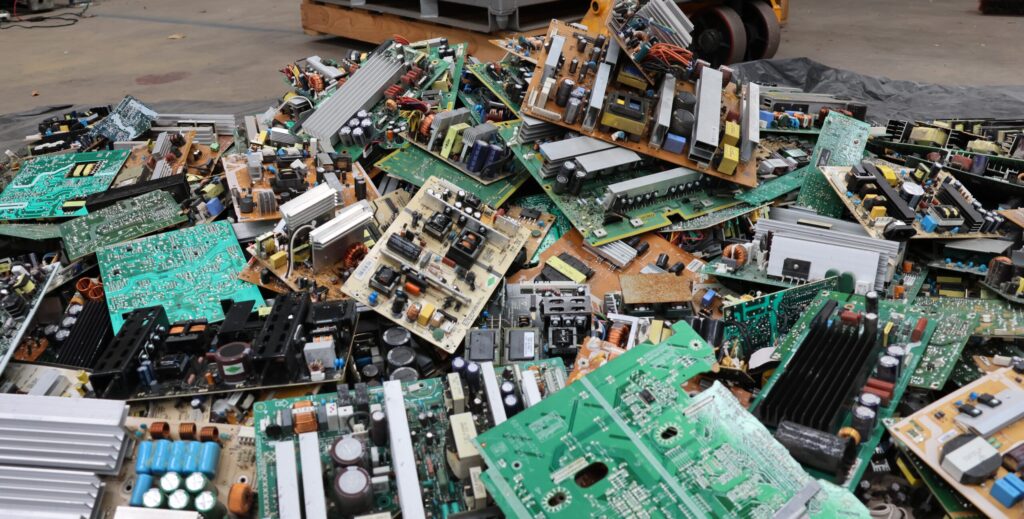
An interdisciplinary team of experts in green chemistry, engineering and physics at Flinders University has developed a safer and more sustainable approach to extracting and recovering gold from ores and electronic waste.
Explained in the journal Nature Sustainability, the gold extraction technique promises to reduce the levels of toxic waste from mining operations and shows that it is possible to recover high-purity gold from recycling valuable components of end-of-life computer printed circuit boards.
The project team, led by Professor Justin Chalker of Flinders University, applied this integrated method to extract high-yield gold from many sources — recovering even traces of gold found in streams of scientific waste.
The progress towards safer and more sustainable gold recovery was demonstrated for electronic waste, mixed-metal waste, and ore concentrates.
“The study introduced many innovations, including a new and recyclable leaching reagent derived from a compound used to disinfect water,” says Professor of Chemistry Justin Chalker, who directs the Chalker Laboratory in the Faculty of Science and Engineering at Flinders University.
“The team also developed a completely new way of making the polymer sorbent, or the material that binds the gold after extraction in water, using light to initiate the key reaction,” he adds.
The new study presents an extensive investigation into the mechanisms, scope, and limitations of the methods, and the team now plans to work with mining operations and electronic waste recycling to test the method at a larger scale.
“The aim is to provide effective gold recovery methods that support the many uses of gold while simultaneously reducing the environmental and human health impacts,” says Professor Chalker.
The new process uses a benign and low-cost compound to extract the gold. This reagent is widely used in water sanitation and disinfection. When activated by saltwater, the reagent can dissolve the gold.
Next, the gold can be selectively bound to a new sulfur-rich polymer developed by the Flinders team. The polymer’s selectivity allows recovery of the gold even in highly complex mixtures.
The gold can then be recovered by triggering the process of “undoing” the polymer and converting it back into its monomer. This allows the gold to be recovered and the polymer to be recycled and reused.
Global demand for gold is driven by its high economic and monetary value, but it is also a vital element in electronics, medicine, aerospace technologies and other products and industries. However, traditional extraction of the metal may involve the use of highly toxic substances such as cyanide and mercury for gold extraction — and other negative environmental impacts on water, air and land, including CO2 emissions and deforestation.
The objective of the Flinders-led project was to provide alternative methods that were safer than mercury or cyanide for gold extraction and recovery.
The team also collaborated with experts in the United States and Peru to validate the method on ore, in an effort to support small-scale mines that would otherwise rely on toxic mercury to amalgamate gold.
Gold extraction normally uses highly toxic cyanide to extract the gold from ore, with risks to wildlife and the environment in general if not properly contained. Artisanal and small-scale gold mining still use mercury to amalgamate gold. Unfortunately, the use of mercury in gold extraction is one of the largest sources of mercury pollution on Earth.
Professor Chalker says that interdisciplinary collaborations between industry and environmental groups will help solve highly complex problems that support both the economy and the environment.
“We are especially grateful to our engineering, mining, and philanthropic partners for supporting the translation of laboratory discoveries into larger-scale demonstrations of gold recovery techniques.”
The lead authors of the new and important study — Flinders University postdoctoral research associates Max Mann, Thomas Nicholls, Harshal Patel and Lynn Lisboa — extensively tested the new technique on piles of electronic waste, with the aim of finding more sustainable and circular-economy solutions to better use the world’s increasingly scarce resources. Many components of electronic waste, such as CPU units and RAM memory boards, contain valuable metals like gold and copper.
Mann states: “This paper shows that interdisciplinary collaborations are needed to tackle the major global challenges of managing the growing stocks of electronic waste.”
Nicholls, an ARC DECRA fellow, adds: “The recently developed gold sorbent is produced through a sustainable approach in which UV light is used to produce the sulfur-rich polymer. Then, recycling the polymer after gold recovery further enhances the ecological credentials of this method.”
Patel explains that “we dumped into a heap of electronic waste and came out with a block of gold! I hope this research inspires solutions with impact for pressing global challenges.”
“With the growing technological and societal demand for gold, it is increasingly important to develop safe and versatile methods to purify gold from multiple sources,” concludes Dr Lisboa.