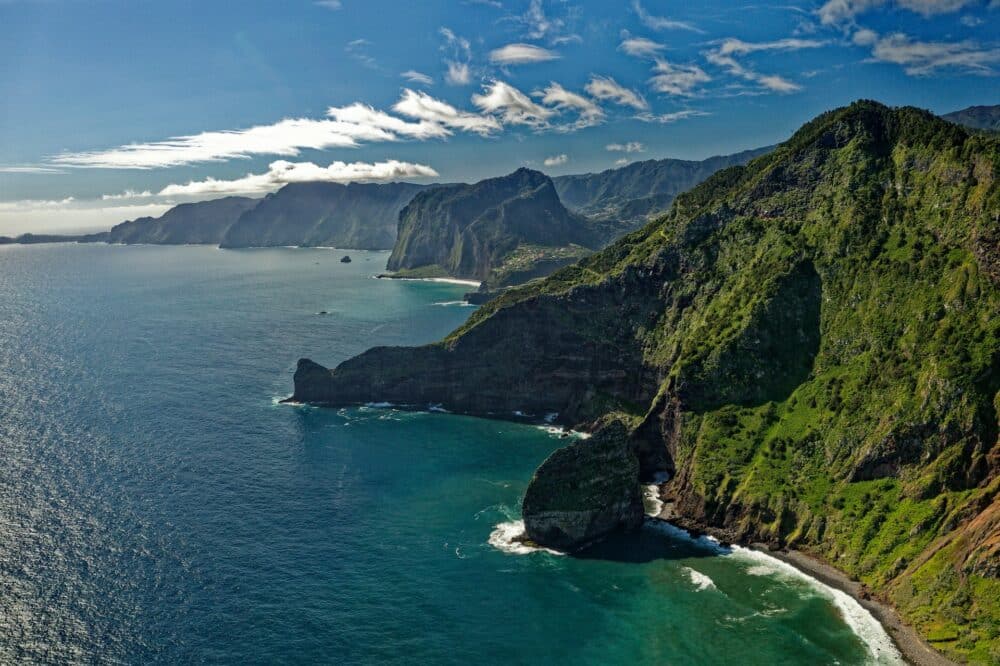
A team of researchers from the Faculty of Science and Technology of NOVA University Lisbon (NOVA FCT) and from the Dom Luiz Institute of the Faculty of Sciences of the University of Lisbon has demonstrated that the magmatism that occurred in Portugal at the end of the Cretaceous originated from a mantle plume, and this plume was responsible for the subsequent formation of the volcanic islands of Madeira and the Canary Islands.
The study, published in the Geology journal, was coordinated by researcher Ricardo Pereira (NOVA FCT), in collaboration with João Duarte and João Mata (Dom Luiz Institute), and originated from the Master’s thesis of Bruno Araújo.
Mantle plumes are stationary structures, while tectonic plates move over them. The study suggests that this plume, located at the boundary between the lower and upper mantle, at a depth of about 660 kilometres, has episodically released small secondary plumes over the last 100 million years. These volcanic eruptions gave rise to rocks found in mainland Portugal and on the submerged platform, as well as in Morocco, Madeira and the Canary Islands.
That phenomenon occurred at the end of the Cretaceous, around 70–100 million years ago. Today, evidence of this activity can be observed in rock formations in the Lisbon, Sintra and Mafra region, as well as further south, in Sines and Monchique. However, due to the movement of tectonic plates, this magmatism is inactive in Continental Portugal.
The results of this research challenge the traditional view that hotspot-type magmatism (such as Hawaii’s) requires the presence of a single ascending mantle plume. Alternatively, this study suggests that stationary superplumes located between the lower and upper mantle can release small secondary plumes intermittently over millions of years, creating complex patterns of magmatism and surface volcanism. This model helps explain the distribution of magmatism along the margins of Portugal and Morocco, as well as the formation of submarine mountain ranges that extend northward from the Canary Islands and Madeira.
In a statement, the team notes that, in addition to contributing to a better understanding of the processes that feed large magmatic provinces, this research may have implications for other regions of the world, such as the formation of the Cape Verde archipelago.
The results of this study are part of a broader set of investigations that include, for example, the use of extinct volcanoes for carbon dioxide storage, a strategy with the potential to mitigate greenhouse gas emissions.