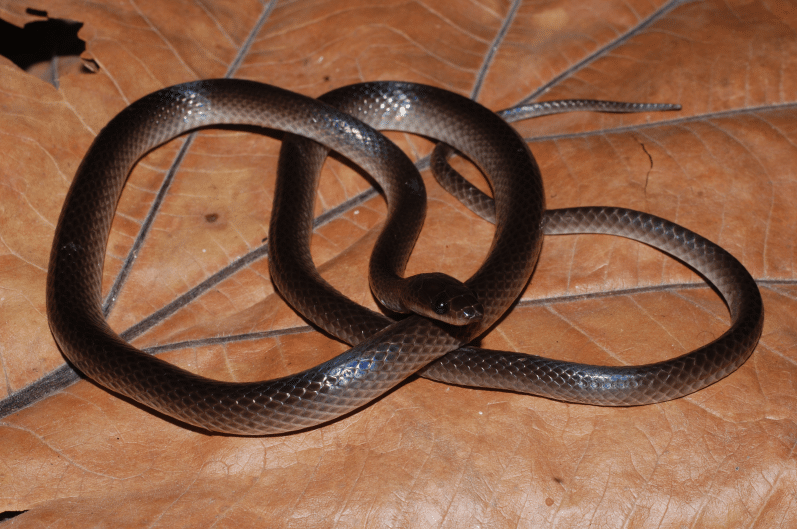
In July 2006, in the forests of Sanduan Province, in Papua New Guinea, a snake was found that seemed different from all others that had been described up to that point. Two decades later, it was confirmed that, indeed, it was a new species.
The animal had been discovered by researcher Christopher Austin, from Louisiana State University (United States of America). The specimen was found 208 meters above sea level, in the village of Utai, in the north of the country, an adult male about 70 centimeters in length, with a very dark brown dorsum showing no pattern, and with a lighter belly.
In 2018, these individuals, based solely on their physical appearance, had been classified as members of the species Lielaphis parvus, but genetic tests now confirm that, in fact, it is a distinct and entirely new species, which the researchers, in an article published in the journal Zootaxa, named Lielaphis slashi.
“It was a combination of physical characteristics, such as differences in the number of scales when compared with other species, and genetic evidence that led us to realize that it is a completely new species,” says Tianqi Huang, a researcher at the Field Museum of Natural History and the first author of the study.
The new species was named in honor of Slash, the drummer of the band Guns N’ Roses. In the article, the researchers say that Saul Hudson (the musician’s real name) is a longtime supporter of museums and zoos and a great admirer of reptiles.
“Over many years, Slash has frequently promoted and advocated for snakes across various social media,” explains the team. Moreover, one of the authors, Sara Ruane, a reptile curator at the Field Museum, says that many of her scientific papers were written to the sound of Slash’s music.
As observing snakes in the wild is “extremely difficult,” much remains unknown about the life of Lielaphis slashi, admits Ruane. However, it is known that species in the genus Lielaphis have large teeth at the back of the mouth, which they use to grasp and eat small and slippery prey, such as lizards, and also eggs of other reptiles.
Furthermore, the researchers point out that, although Guns N’ Roses have been nicknamed “the most dangerous band in the world,” this snake does not produce any venom that could cause serious harm to a person.
Although little is still known about it, Lielaphis slashi, like other animals living in the forests of Papua New Guinea, is under the looming threat of human expansion into its natural habitats.
Ruane says that industries such as coffee cultivation and mineral exploration are putting the habitats of the newly named Lielaphis slashi at risk.
“That is partly why it is important to describe the species that live there. All species must be identified so that we can better understand how ecosystems function and how everything fits into the environment. We cannot conserve animals or other living beings that we do not know,” emphasizes the researcher.