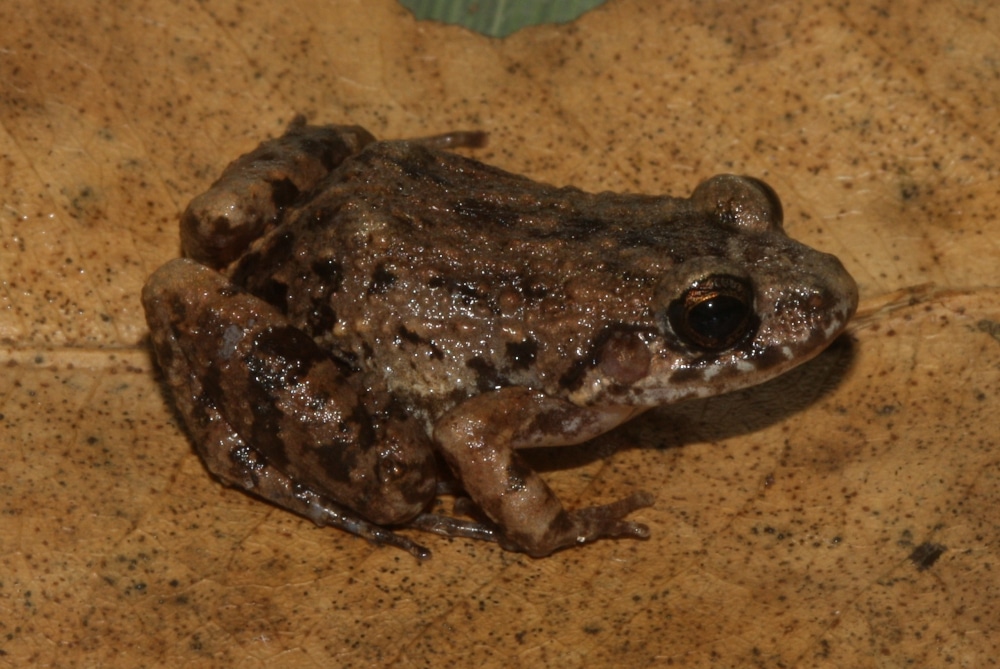
In forest fragments that flank the Moa and Crôa rivers, in the western Brazilian Amazon, researchers from Brazilian and Ecuadorian universities have found a new species of frog.
They named it with the scientific name Adenomera varcena, with the specific epithet (varcena) referring to the Amazonian várzeas, considered fundamental environments for the reproduction and presence of the species, being ecosystems that are flooded by river waters during the times of the year with the greatest rainfall.
In an article published in the journal ‘Ichthyology & Herpetology, the researchers reveal that this is the first record of a species of the genus Adenomera in such a habitat, since these frogs are typically found in non-flooded forests.
To confirm that it really was a new species, they carried out genetic analyses, comparing with the DNA of other known species, examined recordings of the amphibians’ vocalizations, studied the shape of its body and also looked closely at the habitat in which it was found. In the end, it was confirmed to be a species that had not yet been documented.
They explain that the A. varcena differs from other members of the genus by not having a dark blotch on the ventral side of its forearm, as do other Adenomera species. In addition, the calls that males use to attract females and defend territory are also unique, consisting of a short sound with a slow rhythm and other specific acoustic characteristics.
For the team, this discovery shows how much of the Amazon’s biodiversity remains to be discovered, especially among species that morphologically appear very similar, but which, in reality, are distinct.
Regarding the conservation status of the new species, as well as its future, many questions persist for now.
“As we do not yet know in detail the ecological requirements of the species and its natural history [such as the breeding period and mode], it is difficult to predict the impacts of climate change, which could alter the seasonal flooding patterns of the várzea forest ecosystem in this region of the Amazon,” explains Thiago Ribeiro de Carvalho.
The researcher from the Federal University of Minas Gerais (Brazil) and coauthor of the study notes that, since the species has a preference for this type of habitat, it is possible that changes in inundation dynamics could influence, although it is not known to what extent, the frog’s reproductive behavior.
“In a scenario of accelerated loss of natural areas, the formal description of a new species highlights how much we still need to strive to advance studies on our biodiversity. Species can become locally extinct even before they are formally recognized as species, through their naming and description,” stresses the Brazilian scientist.