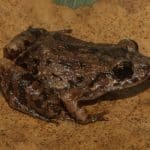
Several species have fascinated observers with their abilities to leap from side to side and into the air from the surface of a lake, as if water were land. One of these species, native to Virginia and North Carolina, is the cricket frog. The way these frogs move on water could give rise to tools for the future of robotics, aquatic vessels, and more.
Jake Socha, the Samuel Herrick Professor of Mechanical Engineering, leads a research team that studies the cricket frog’s unique ability to “skitter,” another name for jumping multiple times in succession. The conclusions of the team were published in the Journal of Experimental Biology, with researcher Talia Weiss as the first author.
“The word ‘skittering’ isn’t actually a well-defined term for this behavior — a naturalist used it to describe a ‘hopping on water’ behavior in frogs in 1949 and, since then, it has been used for this type of locomotion throughout the literature,” Weiss said. “Part of this research is not only studying this behavior in cricket frogs, but attempting to give a more precise scientific definition to ‘skittering’.”
How do they do it? In their studies, Socha’s team discovered that popular views generally state that the frog travels across the water without sinking, but doing so may still require highly specialized anatomy. What does this frog have that other frogs do not?
“Our laboratory has studied a range of animals and many display fascinating behaviors navigating their environment,” Socha said. “The humble cricket frog lives nearby and, even so, surprised us with its abilities, further fueling our curiosity to understand the living world.”
High-speed video for high-speed frogs
The cricket frog is one of the smallest frogs in North America, easily able to sit on the thumb of an average adult. To observe the cricket frog in motion, the team used high-speed videography. They recorded how the frog jumps on land and in water, watching the movement of its legs as it navigated both.
“The team found that frogs sink with every jump. While the “skittering” gives an image of frogs leaping freely, with only their feet penetrating the water surface, the recordings showed a different picture. Socha, Weiss and their team observed that each time a frog descended from a jump, its entire body submerged. The movement was less like a frog leaping and dancing freely on the water, and more like a dive and a leap. Their movements could be more appropriately described as “dolphin-like” leaps, in homage to the movement that a bottlenose dolphin or a dolphin uses: leaping into the air from beneath the surface of the water.”
Takeoff from beneath the water
The reason the cricket frogs seemed to dance on the water when seen with the naked eye is largely due to their rapid movement.
To record this ultra-fast movement, the team used a 20-gallon glass tank and released the frogs inside it. High-speed cameras, capable of shooting up to 500 frames per second, were pointed at the side of the glass tank to capture the action above and below the water surface. When the frogs jumped, the team captured their escape.
The footage was then slowed to a fraction of the original speed. When they viewed the footage, the team observed a surprising finding: the frogs were actually sinking.
“It’s fascinating how easily we can be fooled by the rapid movements of animals,” Socha said. “Here, we are fooled by a frog that looks like a stone leaping, but which in reality is jumping and diving several times in succession. Frogs are big jumpers, but most of them do not exhibit this buoyant behavior, and we still do not know why. Will there be something special about the frog’s jump, or is it simply a matter of the small body size?”
Watching them in slow motion, the team members were able to observe the frog’s movement as it retracted and extended its limbs. They also noted that the angle of its body relative to the water line was an important factor, giving it the ability to balance on the water. They divided each jump cycle into:
Takeoff, from an underwater position
- Aerial, or time in the air after a jump
- Re-entry, back to the water
- Recovery, for the next leap
In just over a second, the frog rose completely submerged, extending its hind legs in an underwater thrust to propel the body above the surface. The hind legs remained extended as they moved through the air, and the forelegs stopped pressing the body to extend forward. The extended forelegs are the first to hit the water upon re-entry, and the hind legs remain extended as it sinks. As it sinks, the hind legs retract and bend backward into a takeoff position. Another jump is performed, repeating the motion.
It is basically a belly flop.
The team observed frogs performing up to eight consecutive jumps, each one fully executed in less than a second.
Understanding the skittering movement is an important discovery for mastering biology, but it also holds other keys. This discovery provides a new physical basis for the future of biologically inspired robotics. It could be applied to a water-testing system that needs to be deployed rapidly, or to an amphibious drone that measures water depth. These futuristic devices may take inspiration from nature to use well-tested methods that frogs have used for centuries.