In the municipality of Torres Vedras, near the small village of Ameal, a group of researchers made an unprecedented discovery about plant life in Portugal many millions of years ago.
In the Vale Cortiço fossil formation, the scientists, including Mário Miguel Mendes, of the Centre for Earth and Space Research at the University of Coimbra (CITEUC), finally uncovered a mystery that for at least a decade has mystified those who study very ancient flora, paleobotanists.
About 140 million years ago, during the Cretaceous Period, the territory that now forms Portugal boasted a great wealth of conifers of the family Cheirolepidiaceae. During the Early Cretaceous, between 145 million and 100 million years ago, these plants dominated the landscape that would become Portugal, having disappeared at the end of the Late Cretaceous, somewhere around 66 million years ago.
Belonging to that family were the frenelopsids, from the genera Frenelopsis and Pseudofrenelopsis. They were plants with “a remarkable capacity for adaptation,” explains Mário Miguel Mendes, who is also a lecturer at Fernando Pessoa University, in Porto. This is because they were able to live and thrive in various types of habitats, from semi-arid to arid, and there are also records suggesting that they may have lived in interior regions with milder conditions.
Therefore, finding in a given locality fossils of frenelopsids, or the pollens produced by them, belonging to the genus Classopollis, reveals that there, many millions of years ago, there existed a hot climate with little water.
It is precisely this type of environment that would have characterized Vale Cortiço during the Cretaceous, and it was precisely there that the same team of scientists found a conifer cone that had not, up to then, been identified anywhere else in the world. It is another piece that helps to compose the puzzle of the ancient life that inhabited that site.
Much more than a simple cone
One might ask, “But what is so special about a fossil of a simple cone?”. To that, Mário Miguel Mendes responds, “when science is done, sometimes the simplest things are also the most extraordinary.”
The cone in question is male and was found in very good condition. Conifers have both male cones, which produce and release pollen grains, and female ones, which receive them to fertilize the ovules that carry, to give rise to seeds, in this case, to pine nuts, as happens with the various species of pine in today’s flora.
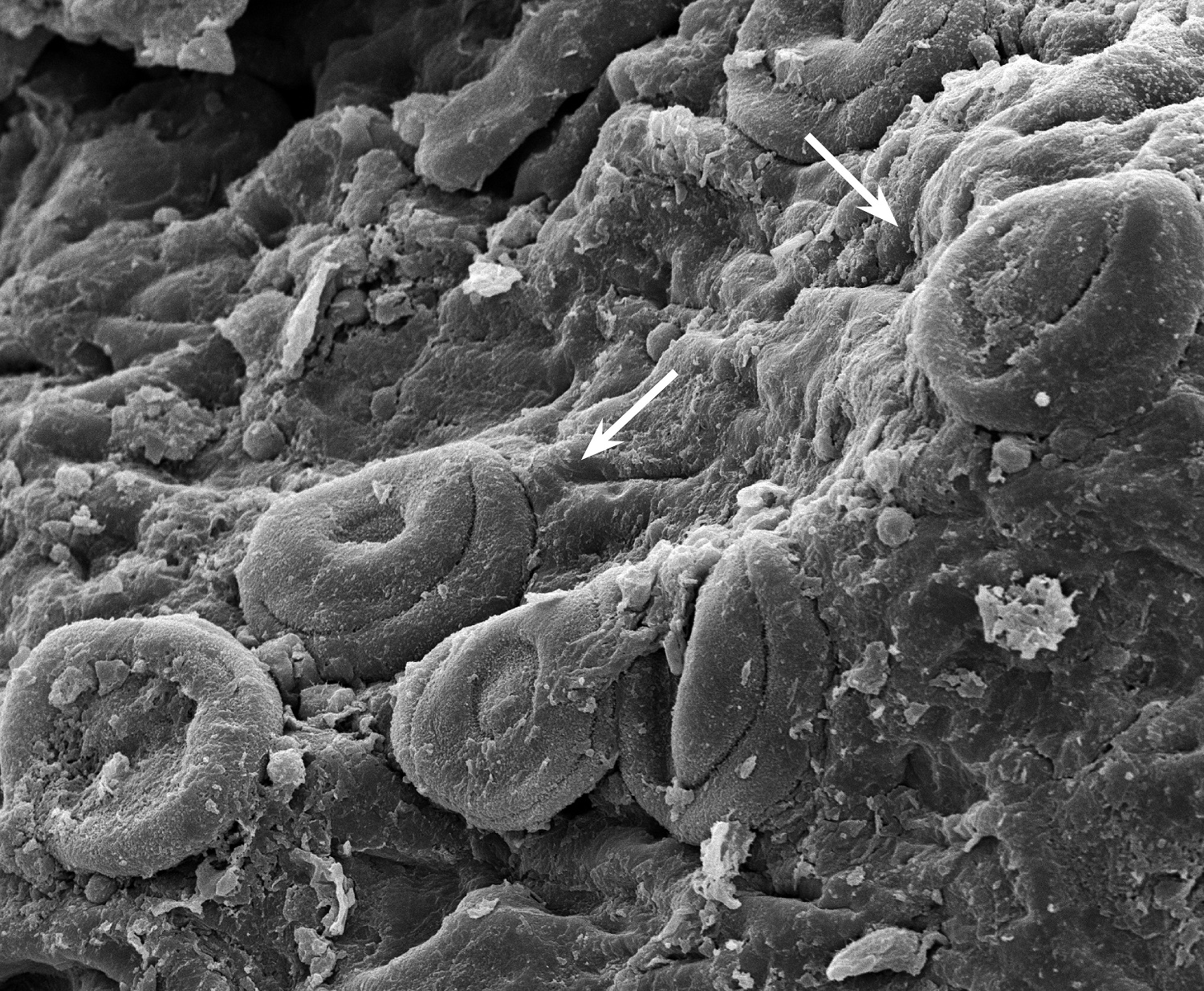
The Portuguese researcher tells us that the cone, just like the ones we are familiar with today, is composed of microsporophylls, the “scales,” arranged in a helical shape. In them pollen grains were found that, through meticulous analyses by transmission electron microscopy, were identified as belonging to the species Classopollis martinottii. Up to then, these pollen grains had only been found dispersed through the sediment, without knowing which plant produced them.
It may seem strange to give the name of a species to a pollen grain, but in paleobotany it is very difficult to find a fossil of a complete plant. “What is generally preserved in the fossil record are the different parts of the plant preserved, but separately,” explains Mário Miguel Mendes. Branch parts at one site, pollen grains scattered through the sediments, cones here and there. Therefore, it becomes difficult to know with total certainty whether an element belongs to one species or another.
To overcome this problem, paleobotanists adopted a taxonomic classification system different from what many know: each element, each part of the plant, receives its own genus and species name. Thus, even if they belong to the same plant, in the case of not knowing that, it is as if each were a species in its own right.
The cone now discovered, unique in the world for now, was given the scientific name Classostrobus amealensis, for producing pollen of the genus Classopollis and for having been found in Ameal.
Then remains to answer a question: which plant produced the cone? In Vale Cortiço, where the cone was found, there is a large amount of frenelopsid evidence of the species Frenelopsis teixeirae and Pseudofrenelopsis dinisii. However, in the fossil levels where the researchers unearthed the cone, the remains of F. teixeirae were the most abundant.
Does that mean the cone belonged to a Frenelopsis F. teixeirae? Since it was not found attached to any branch, at first it becomes difficult to say which of the plant species produced it. But this is precisely where a “detective work” comes in to join all the evidence and create a clearer image of what happened.
CSI: Paleobotany
To try to understand what plant produced this unique cone, Mário Miguel Mendes and his team, which includes researchers from Russia, the Czech Republic and the Netherlands, pieced the puzzle together. The cone was found in layers where fragments of F. teixeirae are abundant and far more numerous than those of Pseudofrenelopsis dinisii. But that alone is not enough.
The researchers looked more closely and realized that the small openings that allow plants to exchange gases with the environment, the stomata, had a similar organization in the cone and in F. teixeirae. For all that, Mário Miguel Mendes considers that “it is almost certain” that the cone was produced by that species of frenelopsid.
“This CSI work allowed us to assemble the puzzle,” he says. With all these scientific proofs it became clear that the pollen Classopollis martinottii is produced by the cones Classostrobus amealensis, which, in turn, will very likely be produced by the plant Frenelopsis teixeirae.
“From here on, when someone in Spain, France or England identifies pollen grains of Classopollis martinottii dispersed in the sediment, they will know its origin. And it was not an easy task, because I have been working on this flora since 2010!”, reveals Mário Miguel Mendes.
To dispel the remaining doubts, it is necessary that one of these cones be found attached to a branch of Frenelopsis teixeirae, “because, as for the rest, it is all there.”
Looking at life from millions of years ago is crucial to understand how it arrived at the days of today. The conifer family Cheirolepidiaceae has long been extinct, but, as the researcher cautions, “it is not possible to understand modern flora without looking to the past.”
“And it is these simple and seemingly insignificant things that help us to piece together the puzzle and understand the vegetal diversity of the past.”
These discoveries will be shared with the world in an article published in the May issue of the international journal ‘Cretaceous Research’.