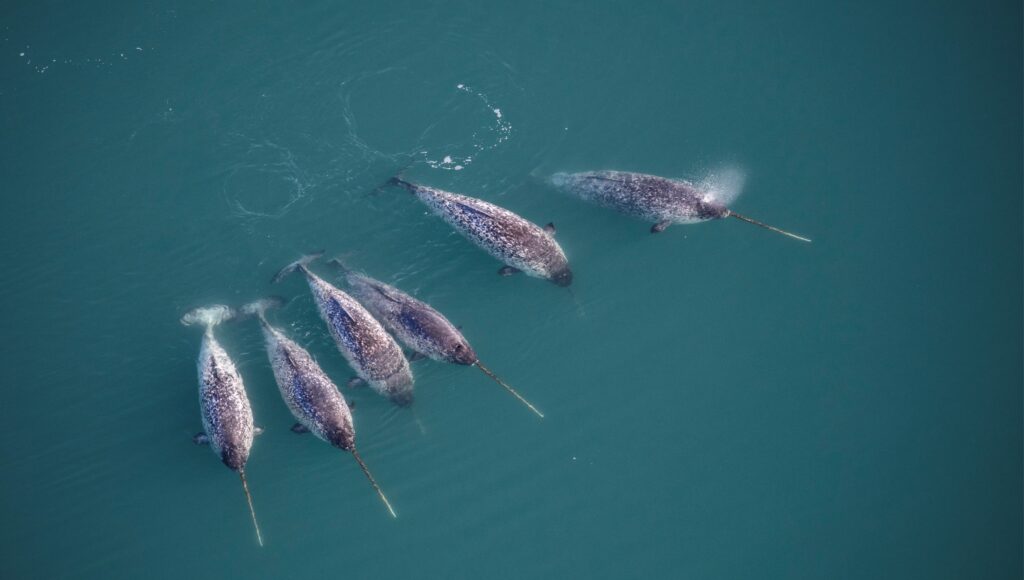
An international team of researchers has discovered how narwhals are able to grow a tusk that can exceed two metres in length and remain extraordinarily straight. The study, published in the journal Nature Communications, shows that the spiralled feature of the tusk, known as the “unicorn of the sea” tusk, results from microscopic structures that develop in opposite directions.
The narwhal’s tusk is, according to the researchers, the only known example in nature of a straight tusk. Although it displays a left-handed spiral, how this macroscopic structure relates to the microscopic organization of the tissues that constitute the tusk remains to be clarified.
To understand this mechanism, Henrik Birkedal and his colleagues combined different imaging techniques, allowing them to analyze the tusk’s structure across multiple scales. The observations revealed that the large helical structure is produced by the microscopic organization of mineralized collagen, one of the tusk’s main components.
The collagen fibers are predominantly aligned along the length of the tusk. However, small changes in their orientation give rise to two helical structures that develop in opposite directions: a left-handed helix in the outer layer, the cementum, and another to the right in the dentin, an inner layer.
The researchers suggest that this arrangement in opposite directions allows the tusk to grow straight, while simultaneously maintaining its left-handed spiral. The mechanism could explain how such a long structure can preserve its shape without losing the strength required.
Further studies will be needed to understand how these structures form during the animal’s development. Still, the results show how microscopic structural patterns can determine features and functions observable at a much larger scale, contributing to a better understanding of the narwhals’ extraordinary anatomy.