It was six or seven million years ago that chimpanzees and humans began to evolve in divergent directions, separating from a common ancestor that would have been capable of climbing trees and living among the branches.
Chimpanzees have flexible ankles that allow them to climb trunks with great dexterity, but monkeys (a group distinct from the great apes) tend to navigate forest landscapes using primarily their arms to leap from branch to branch, and they tend to spend less time on the ground.
These differences make uncertain the type of common ancestor that primates would have had: one that lived between the ground and trees and climbed trunks, or one that lived mainly in the forest canopy?
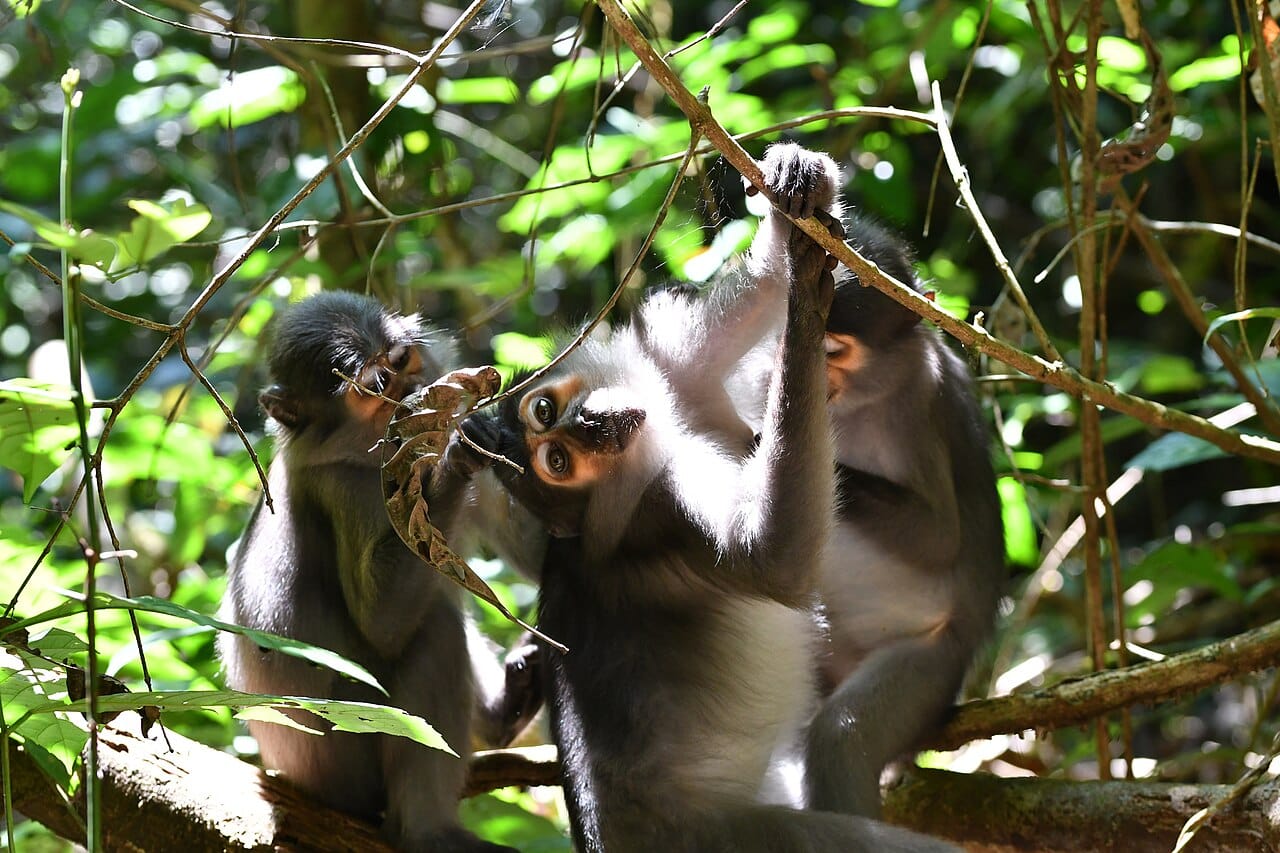
A recent investigation suggests that these two modes of life are not necessarily incompatible. Through observations and measurements, a group of researchers at Ohio State University (United States of America) reveals that the gray mangabey (Cercocebus atys), a forest monkey of West Africa known for not having the flexible ankles of chimpanzees, nevertheless possesses a flexible bone structure in its feet that allows it to climb tree trunks to hide, forage for food, or sleep.
“Behavioral inferences are being made based on fossils, and some say that a monkey cannot climb vertically as well as a great primate,” says Luke Fannin, the first author of the study published in the journal PNAS.
“We are saying there is a functional equivalence here. Therefore, vertical climbing cannot be ruled out simply because something does not have a foot similar to a chimpanzee’s,” he adds.
The researcher filmed gray mangabeys in Ivory Coast to study how they move and interact with trees.
Identifying the last common ancestor of all primates is considered fundamental to understanding how bipedalism, or the ability to walk on two legs, arose, which is typical of humans and relatively uncommon in other primates.
The team argues that even if that ancestor had feet more similar to those of modern monkeys and not so much as those of today’s great primates, it is possible that, nonetheless, it could have climbed trees like a great primate.
“Part of paleoanthropology consists of understanding how our evolution happened, and it is often done through the way we move, since modern humans move in a very different way from our cousins, the chimpanzees, who are the living primates with whom we are most closely related,” explains Fannin.
Although they suggest that the shape of the foot is not necessarily the best indicator to determine whether the common ancestor of primates was more like a great primate today (such as gorillas, chimpanzees, orangutans, or humans) or like a monkey (tailed primates and typically smaller), these researchers say that more fossils are needed to achieve greater clarity about the form of life that gave rise to the order of mammals to which we belong.
We are still far from knowing who that common ancestor was, but the researchers believe that, whoever it was, it was a primate that climbed trees.