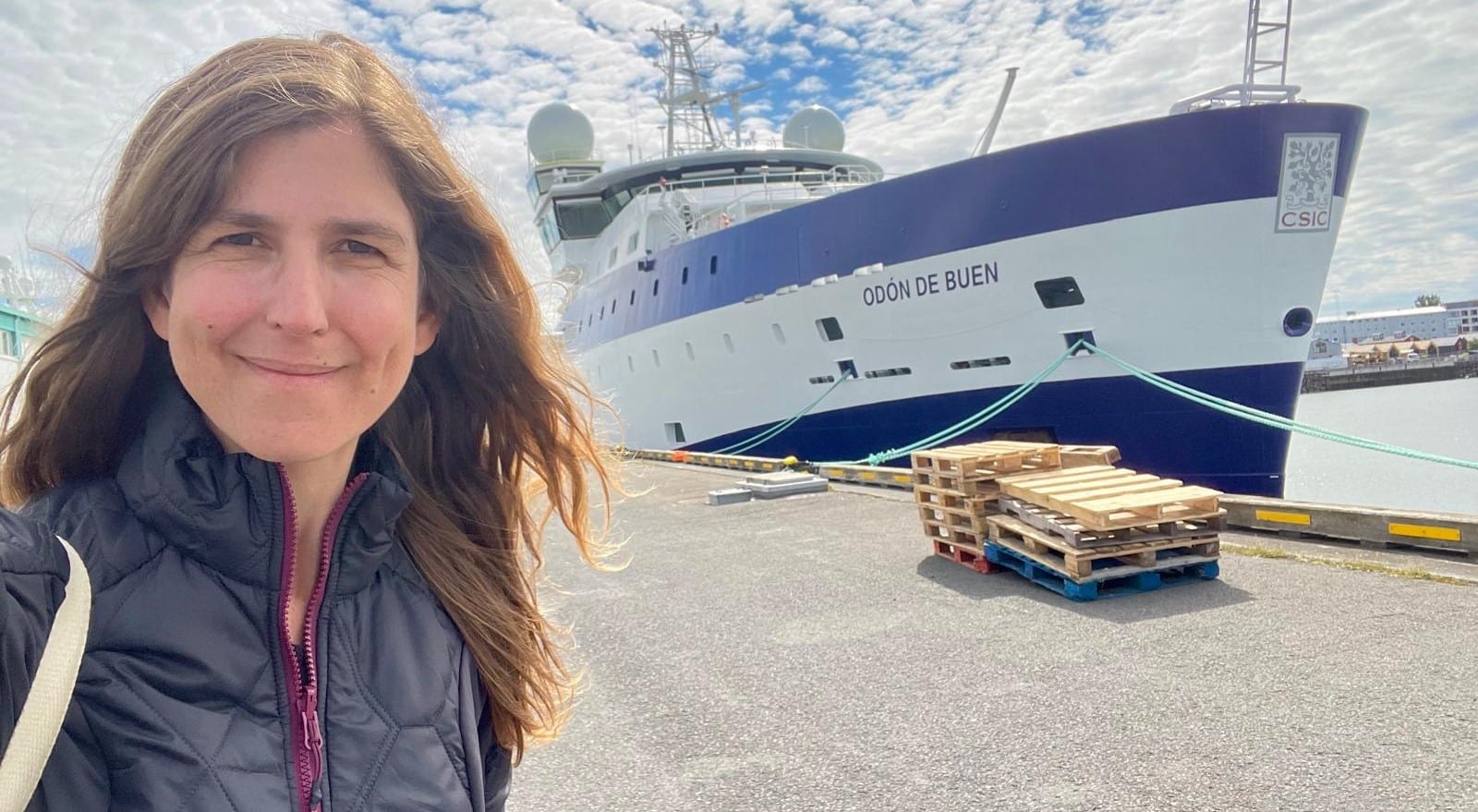
How does the dynamics of the ocean influence the sequestration of carbon from the surface to the deep waters in the Greenland Sea? And what is the role of plankton in this process? These are some of the questions being investigated within the scope of the international scientific expedition IMAGE – Impact of Mesoscale Activity on Greenland Sea Biogeochemistry, which is taking place between Iceland and Svalbard through September 3.
Representing Portugal on this mission is Catarina V. Guerreiro, a researcher at the Faculty of Sciences of the University of Lisbon (Ciências ULisboa), part of MARE – Centro de Ciências do Mar e do Ambiente / ARNET and the Instituto Dom Luiz (IDL). She is the only Portuguese researcher on board, joining an international team of researchers from Spain, Germany, Denmark, France, the United Kingdom, and China.
The expedition aims to better understand the processes that control the biological carbon pump in the Greenland Sea, namely how the ocean dynamics influence plankton communities and, through them, the uptake of carbon in the surface waters and its subsequent transfer to the interior of the ocean. By transferring carbon from the surface to deeper waters, the biological pump contributes to the ocean’s capacity to store carbon and, in so doing, to regulate atmospheric CO2 concentrations and the climate. Understanding how this process works takes on particular importance in an Arctic that is undergoing rapid changes in temperature, ice cover, stratification, and ocean circulation.
The role of plankton in carbon transport
On the expedition, Catarina Guerreiro is particularly focused on the carbonate pump, studying coccolithophores and other calcifying planktonic organisms. These organisms use the carbon dissolved in seawater to produce calcium carbonate “shells” that coat their cells or enclose the organism itself and which, after their death, can sink, transporting carbon from the surface to the interior of the ocean. By associating with aggregates of organic matter, these calcareous structures can also promote the sinking of those aggregates, influencing the amount of organic carbon that reaches the deep ocean.
“This is my first Arctic expedition and it represents an extraordinary opportunity to explore, in a completely different context, questions I have been investigating in other regions of the ocean. I am particularly interested in understanding how calcifying plankton links the organic and carbonate carbon pumps, and how these surface processes influence the carbon that is exported to the deep ocean,” explains Catarina V. Guerreiro.
Throughout the mission, the team collects samples and conducts physical, chemical, and biological measurements along the water column, seeking to relate mesoscale oceanic structures – including vortices, fronts, and filaments – to the composition and productivity of plankton communities and to the fate of the carbon-rich organic material produced in the surface waters.
For the researcher, “participation in IMAGE also represents an opportunity to strengthen the international collaboration of ULisboa Sciences in the areas of marine biogeochemistry, plankton ecology, and the carbon cycle, as well as to compare the data collected in the Arctic with observations made in other regions of the ocean, including the Southern Ocean.”
The expedition’s results are expected to contribute to a better understanding of how these oceanographic and biological processes regulate biological carbon export and how they may respond to the rapid environmental changes underway in the Arctic. The knowledge gained could also help anticipate how these changes may affect the functioning of Arctic marine ecosystems.
The IMAGE expedition departed Reykjavík, Iceland, on August 2, and is expected to arrive in Svalbard, Norway, on September 3, 2026. The mission is led by IOCAG-ULPGC and co-led by IIM, involving several international institutions, including ULisboa Sciences through MARE/ARNET and IDL.
All updates about the expedition can be followed via the official blog