
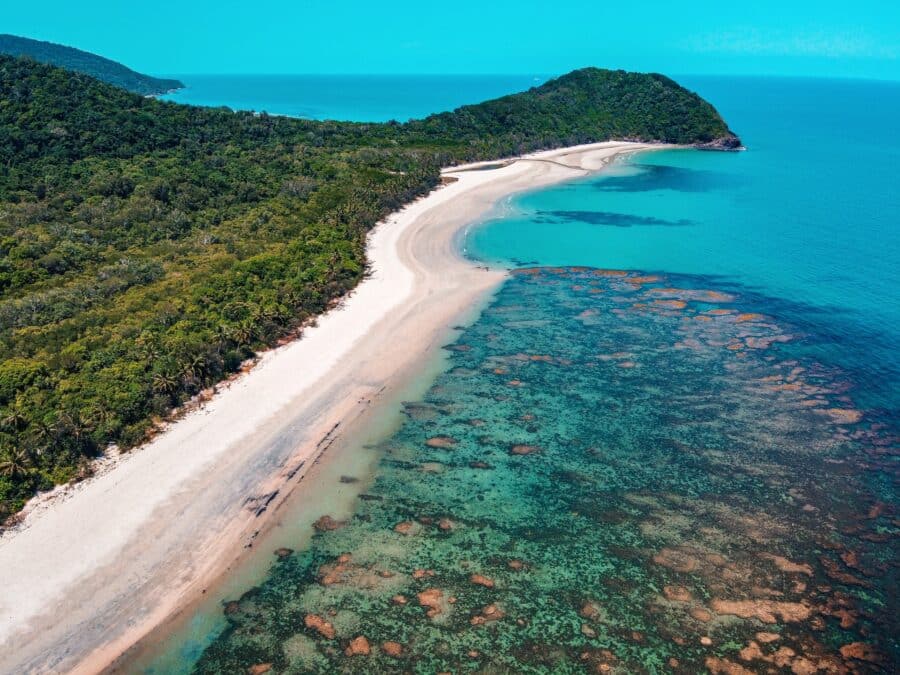
Between August 2025 and June this year, the Great Barrier Reef showed signs of recovery from the impacts of the mass bleaching event in 2024, but the warming threat still persists.
In the annual report on the world’s largest coral reef, which stretches for more than two thousand kilometres along the northeast coast of Australia, government scientists from the Australian Institute of Marine Science reveal that coral cover in all three regions of the Great Barrier Reef has increased slightly or remained at levels similar to those recorded in the summer of 2024-2025.
Coral cover increased by 16.7% in the northern region and 10.2% in the central region. Only in the southern region was there a slight decrease of 2%. The researchers say that in all three regions coral cover remains above or slightly below the long-term average.
The pause in the decline recorded at the Great Barrier Reef, greatly aggravated by the mass mortality event of the 2024 summer, was largely due to intense rainfall associated with the summer monsoon season in that region of the world.
“The reef again endured a summer with sea surface temperatures above average, but the late-summer monsoon, which increased cloud cover and lowered sea temperatures, probably limited the severity and extent of bleaching in the summer of 2025/26,” explains Mike Emslie, director of the agency’s Long-Term Monitoring Program.
Of the total of 121 coral reefs monitored for this year’s report, 12 had cover between 50% and 75%, 42 between 30% and 50%, and 64 between 10% and 30%. Only three reefs had cover below 10% of the historical cover and none showed cover above 75%.
Thus, between August 2025 and June 2026, 16% of the Great Barrier Reef’s reefs experienced a decline, 56% showed no significant changes, and 28% even increased coral cover.
Bleaching continued to be present during the 2025-2026 Australian summer, which will have hindered a more substantial recovery.
“Although many reefs did not lose coral cover, bleaching probably prevented the ongoing increases in coral cover that would normally be expected in the absence of disturbances,” notes Emslie.
Although this year’s results suggest the early stages of a recovery and coral cover levels are higher than in many other similar ecosystems around the world, the Great Barrier Reef remains under pressure.
“Although signs of recovery are encouraging, the risks to coral reefs are increasing. We can help them survive the threats arising from climate change by reducing global emissions, by effective reef management and by developing data-driven scientific interventions that support the adaptation and recovery of reefs,” states Selina Stead, chief executive of the Australian Institute of Marine Science.