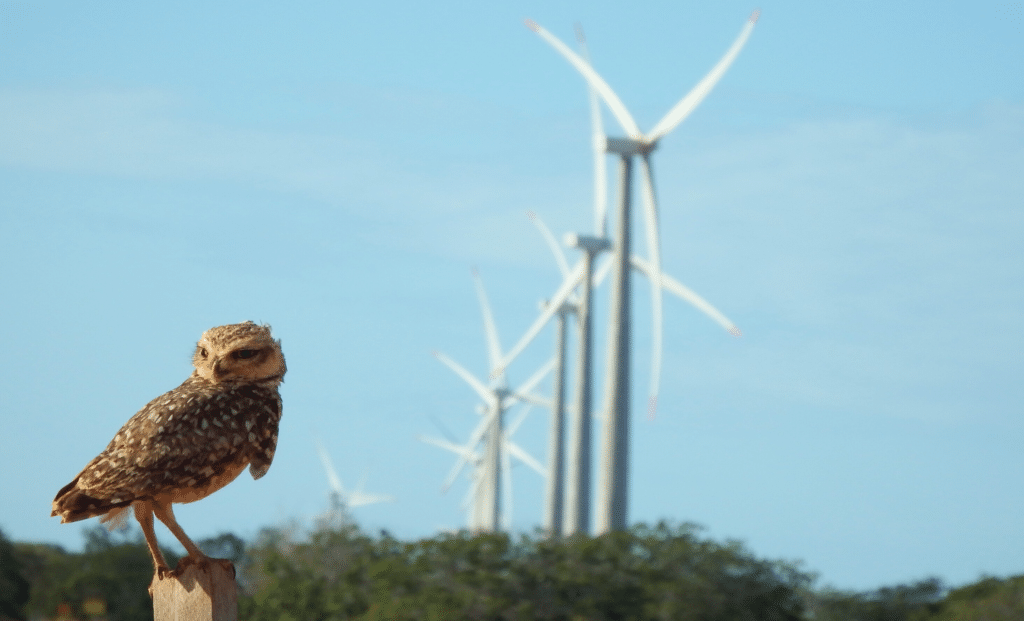
Galp is studying the installation of a wind project with around 22 wind turbines in the municipalities of Ourique and Odemira, in the Beja district, and an approximate capacity of 158 megawatts, the company explained today.
In response to written questions from the Lusa agency, Galp clarified that the so-called Mira Wind Project, which covers these two municipalities in the Beja district, is in an early development phase.
The project ‘consists in the wind hybridisation of a solar park in Ourique,’ she/he stated.
According to Galp, in June 2026, it submitted to the Portuguese Environment Agency (APA) a Definition of Scope Proposal (PDA), which constitutes the first stage of the environmental impact assessment process.
This proposal is intended to ‘collect contributions from the competent entities’ ‘on the topics that should be studied and the methodologies that should be used in the future Environmental Impact Study (EIA),’ he added.
According to the company, only after the conclusion of this stage will the EIA be developed, in which the ‘potential impacts of the project, alternatives considered’ and ‘the measures to be implemented to eliminate environmental risks’ will be evaluated.
In this regard, he emphasized, ‘the final configuration’ of the project, the ‘number of wind turbines or the exact location’ of some of the structures ‘may still be adjusted according to the results of the technical and environmental studies that will be carried out’.
“In a preliminary configuration, the project contemplates up to 22 wind turbines, corresponding to an installed capacity of around 158 MW [megawatts]”.
The construction of this park, according to Galp, should not begin ‘before 2029’, given the different licensing and development phases still underway.
The project foresees the ‘hybridisation of a photovoltaic plant in development in the Ourique region’, combining the ‘production of solar and wind energy in the same area’.
In this way, the company will ensure ‘a more efficient use of existing electrical infrastructures’.
However, Galp did not advance at this stage with the estimated investment amount, explaining that the final configuration of the venture is not yet defined.
It also clarified that the Mira Project ‘is completely distinct from the Cachenas project,’ which covered four parishes in the municipalities of Odemira (Beja), Santiago do Cacém and Sines, in the Setúbal district, and was subsequently canceled.
This new enterprise ‘does not arise as a consequence of the cancellation’ of the Cachenas Wind Park, he assured.
According to the company, the Cachenas project was ‘associated with the direct supply of renewable energy to the hydrogen electrolyzer located at the Sines Refinery’.
Meanwhile, the Mira Wind Project ‘was conceived as a hybridisation project intended to inject energy into the National Electrical Grid’, it maintained.
“They are projects with distinct objectives, frameworks and development models,” the company assured, noting that the Mira Project has been ‘under study for several years’ and ‘its development has progressed independently of the Cachenas park’s evolution’.
The company also revealed that it has been developing contacts to ‘present the project and collect contributions’ from the populations, notably through the parish councils, with which it established ‘a channel of dialogue’, and with the town halls of Odemira and Ourique.