For centuries, dried figs were the Algarve’s most exported product. By 1708, the region sent between 4,500 and 6,000 tonnes per year to the Netherlands, Belgium, France and England. Quinta da Fornalha, a family-owned estate since 1770, pays homage to that trade with the BIO Fig Mosaic: a slice of pressed fig with roasted almonds and lemon zest, with no added sugar. And it also revives the logic that sustained it: bringing together the production of many small farmers to reach distant markets, as stated in a press release.
Eight centuries of figs overseas
According to the same source, in the XII century the geographer Al-Idrisi already described the territory of Silves as famous for its figs. In the XIII century there are records of exports to Flanders, and the trade grew in the following centuries. In the XVI century, Friar João de São José wrote that the fig groves were the main farms of the Algarve.
The fig was so valuable that it served as a currency. In 1605, a French trader had to commit to importing 16 moios of rye in order to export 800 pieces of fig. During World War I, the Algarve reached an average export of 8,800 tonnes per year. Until 1922, the fig occupied first place in Portugal’s external trade of dried fruits.
An economy of many
This wealth did not come from large properties, but from many family fig groves scattered across the region. Each family dried its fig in the almeixares, and many women worked in sorting and packing in the smokehouses. The fig was then gathered into bundles and loaded at the ports for the Kingdom and for foreign markets. It was an economy that redistributed: the value of each ship was shared among many households.
An organized economy
In the early 20th century, Casa de Odeleite, belonging to João Xavier de Almeida and Claudina Dias, paternal great-aunt of Rosa Dias, was one of the region’s most important commercial entrepôts. It received carob, almonds and figs from the families of the surrounding hills, often on consignment, and sent them along the Ribeira de Odeleite and the Guadiana, partly for export. In return, the population sourced flour, textiles and soap there. In the crisis that followed the 1929 crash, many foreign sales were left unpaid, and bankruptcies swept through the Algarve mountains like a domino, from the largest to the smallest. And export became a distant memory. And being a farmer came to be synonymous with happily impoverishing.
The Quinta da Fornalha today retakes this logic. It groups fresh organic figs for export, bringing together in a single shipment the production of small regional producers for more than 13 years. Alone, a small farmer does not reach an international buyer; organized, they do. “That’s how a sustainable economy should work: small players reorganize themselves and gain scale without losing their identity,” says Rosa Dias, manager of the estate.
The next step is to do the same with dried figs. Today, most dried figs consumed in Portugal come from abroad: according to INE data from 2018, the country imported about 1,100 tonnes and exported only 116. Turkey is the world’s largest producer. “Each BIO Fig Mosaic sold helps create the demand that the farm needs to also buy dried figs from small producers in the region,” says Rosa Dias, “it is necessary to value our agricultural and gastronomic culture.”
The fig returns to travel far
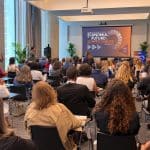
Centuries after the ceiras that left from Monte Figo, the Algarve fig has again crossed the oceans. As part of the strategy to return to export, Quinta da Fornalha presented the recent BIO Fig Mosaic and its fig sustainability line — from fresh to truffles — during last week, in the PL-PEX area, concurrently with the Macau International Fair (MIF 2026), where it was integrated in the AJAP – Association of Young Farmers of Portugal – delegation. The high acceptance of the products among visitors led to an invitation to present them live on TDM radio and television.
The BIO Fig Mosaic: a slice of that old pressed fig
Cerro de São Miguel is still known today as Monte Figo. According to the family’s memory, there and along the entire coast there departed blocks of pressed figs weighing 30 kg, compacted into ceiras and sealed with beeswax, which insulated the fruit from air and humidity on sea journeys. The BIO Fig Mosaic reinvents this pressed fig with roasted almonds and lemon zest.
The result is a natural energy bar that can be cut with a knife. It has a high fiber and potassium content, is a source of calcium and has low sodium. [to be confirmed with the nutritional analysis] In a typical energy bar, the ingredient list easily runs into double digits. The BIO Fig Mosaic has three ingredients, all organic, with no added sugar or additives to extend shelf life: it is the vacuum that protects it. It is available in 100 g slices and 500 g blocks.
A Tree for the Climate Ahead
September 2026 was the hottest in Portugal since 1931 and one of the driest of this century. In the Algarve, where rainfall is falling every year — in Faro, the average annual rainfall dropped from 512 to 455 mm between the climatological normals of 1981–2010 and 1991–2020 — the fig tree is among the best-adapted fruit trees. At Quinta da Fornalha, the fig trees are drought-fed, without irrigation: they only receive water during the establishment of the orchard. Afterwards, the roots descend through the barrocal and draw water from the aquifers that rise through the limestone. And they require little fertilizer. On the farm, each fig is used in full in six products — fig jam, fig chutney, dried figs, figs roasted with piri-piri, fig truffles with cocoa and fig truffles with almond —, to which the BIO Fig Mosaic is now added. From the fig, only the stem remains.
This philosophy — Less is More — extends to packaging, in 100% recycled and recyclable glass or compostable kraft, and to a certified organic and regenerative management since 1994.
The products of Quinta da Fornalha can be found as welcome gifts in several Algarve hotels and for sale at Apolónia supermarkets, at A Vida Portuguesa stores, at the farm itself and in dozens of other quality small establishments.
Product data
| Field | BIO Fig Mosaic |
| Ingredients | Dried fig, roasted almond, lemon zest (all organic) |
| Added sugar | None |
| Formats | 100 g slice · 500 g block |
| Packaging | Vacuum |
| Certification | EU Organic (PT-BIO-03) |
| Where to buy | A Vida Portuguesa · Apolónia Supermarkets |