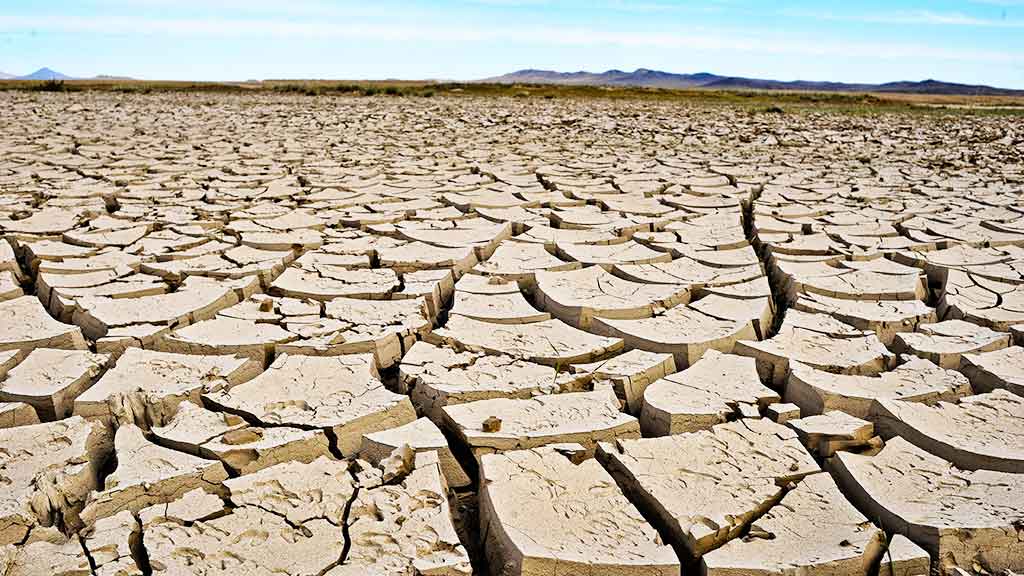
El Salvador has imposed the highest level of alert due to the drought associated with the El Niño phenomenon, which caused crop losses, announced by the Civil Protection of the Central American country.
“A red alert has been declared due to meteorological and agricultural drought across the entire national territory,” said the Civil Protection of El Salvador on Tuesday, on the X social network.
This comes at a time when the country is facing a generalized drought and has recorded 14 record-high temperatures in August, according to local environmental authorities.
El Niño is a global climatic phenomenon that arises from variations in winds and sea surface temperatures over the tropical Pacific Ocean.
With this natural phenomenon, which returns every two to seven years, surface waters in the central and eastern equatorial Pacific warm, which for months causes substantial changes in wind regimes, pressure, and rainfall on a global scale.
The Civil Protection of El Salvador said that the maximum alert implies, among other measures, increased monitoring of water resources and crops, the identification of areas in a state of emergency, and strengthened epidemiological surveillance.
The lack of rains led to lower water levels and crop losses in the country.
According to the Chamber of Commerce of small and medium agricultural producers of El Salvador, the first cereal harvest is expected to show an overall loss of about 20% of production.
The Ministry of Agriculture had already announced food aid for the families of farmers affected by the drought.
El Salvador is partially located in the Central American “dry corridor,” an arid belt particularly vulnerable to extreme weather events.
The same is true for parts of Honduras, whose southern and western regions suffered losses in maize and beans crops. The Honduran Government put nearly 80% of the country on alert.
The United Nations World Food Programme recently estimated that Central America is likely to be “the region most affected in terms of relative increases in food insecurity” due to El Niño.
The phenomenon, which aggravates human-caused climate change, is expected to be “the most intense” observed in more than a century, warned on Friday the Met Office, the United Kingdom’s national weather service.
El Niño adds to a trend of warming oceans due to the accumulation of greenhouse gases in the atmosphere.
On Monday, the European Copernicus Observatory announced that the surface water temperature of the world’s oceans reached 21.1°C, on average, on Saturday, an absolute daily record, due to global warming and El Niño.
The temperature record surpassed the one set in March 2024, at 21.09°C, at a time when scientists say El Niño could be the most significant ever recorded.