An international team of researchers found a logic in the apparent disorderly accumulation of bodies in an ancient Egyptian tomb, concluding that the arrangement of the mummies reveals changes in funerary practices over hundreds of years. The study, published in the journal Frontiers in Environmental Archaeology, analyzed one of the chambers of tomb TT 209, in the Theban Necropolis, opposite Luxor, a historic complex that gathers more than 400 tombs.
The investigation allowed reconstructing how Chamber Three of TT 209 was used and reused from its construction, during the Twenty-Fifth Dynasty (754-656 BCE), up to the Ptolemaic period (305-30 BCE), when it was abandoned. The researchers identified 16 human mummified individuals, one mummified dog, and a disturbed deposit containing the remains of at least four other people.
“The detailed study of the bodies does not indicate a chaotic accumulation nor a loss of the original ritual over time. On the contrary, there was a spatial logic, in which each new burial adapted to the presence of the previous bodies – a kind of funerary memory in the processes of reuse,” explains the first author, Jared Carballo-Pérez, a researcher at the University of La Laguna.
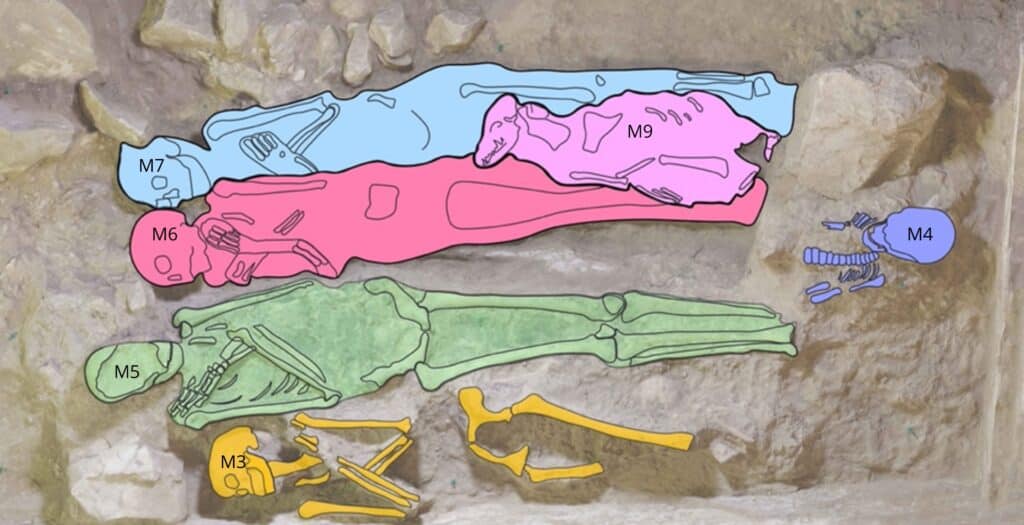
To understand the evolution of the use of the funerary space, the team excavated the chamber, photographed the mummies, and recorded the position, orientation, and relationship of the bodies with the tomb’s structures. Nine burial deposits were identified, with individual and multiple interments, accompanied by different funerary objects.
In the oldest deposits, the bodies were relatively separated and were placed in coffins. “The first individuals buried here seem to have belonged to higher social strata, as they were buried in coffins, with funerary nets and amulets, and with a set of valuable objects, including the contents of Phoenician amphorae, many of which were found beside the bodies,” explains Miguel Ángel Molinero Polo, professor of Egyptology at the University of La Laguna and senior author of the study.
Later, at the end of the Twenty-Fifth Dynasty and during the Persian period, between about 680 and 404 BCE, the bodies began to be placed in the spaces that remained available, leading to a denser use of the chamber. The researchers also identified changes in the position of the limbs. In some interments, for example, one arm was bent, whereas in earlier phases it was common for the arms to remain extended.
During the Persian period there was also a transition from individual deposits to a vertical organization of the bodies. The overlapping of mummies was identified in two-thirds of the interments present in the chamber.
A mummified dog among the dead
In the southeast area of the chamber, four human mummies and one mummified dog were buried on top of each other during the Ptolemaic period. The bodies arranged in vertical stacking did not have coffins, but showed signs of careful mummification and were associated with jars placed vertically, which appear to indicate a specific ritual, absent in the earlier phases of the tomb’s use.
“There is a detail that I consider particularly beautiful: the presence of a mummified dog placed directly above the mummies of a man and a woman,” says Carballo-Pérez. According to the researcher, this arrangement “could indicate a close relationship between these human individuals and the animal.”
The presence of the dog could also reflect a transformation of ritual practices. “It could also reflect an additional change in ritual practice, with the animal taking on the role of psychopomp, a symbolic helper on the journey to the afterlife,” adds Molinero Polo.
Other changes in the arrangement of the bodies reinforce this interpretation. In later interments, some individuals were placed with both arms bent over the chest, in a position that Egyptologists designate as the Osirian position.
For the researchers, the overlap of the bodies does not mean, therefore, that the tomb fell into disorder or that funeral rites were abandoned. The chamber would have functioned as a continuously reactivated space, in which new burials altered the organization and the meaning of the space without completely erasing the past.
The team acknowledges that, in some deposits, it is difficult to determine the exact sequence of interments and reconstruct the intentions associated with each intervention. The use of the chamber over several centuries, floods, fires, and successive entries into the tomb contributed to displacing sediments and materials.
“What we present, nevertheless, means that deposits previously considered ‘disordered’ can be reinterpreted,” concludes Carballo-Pérez. “This helps us to better understand the social behaviors associated with funerary practices.”