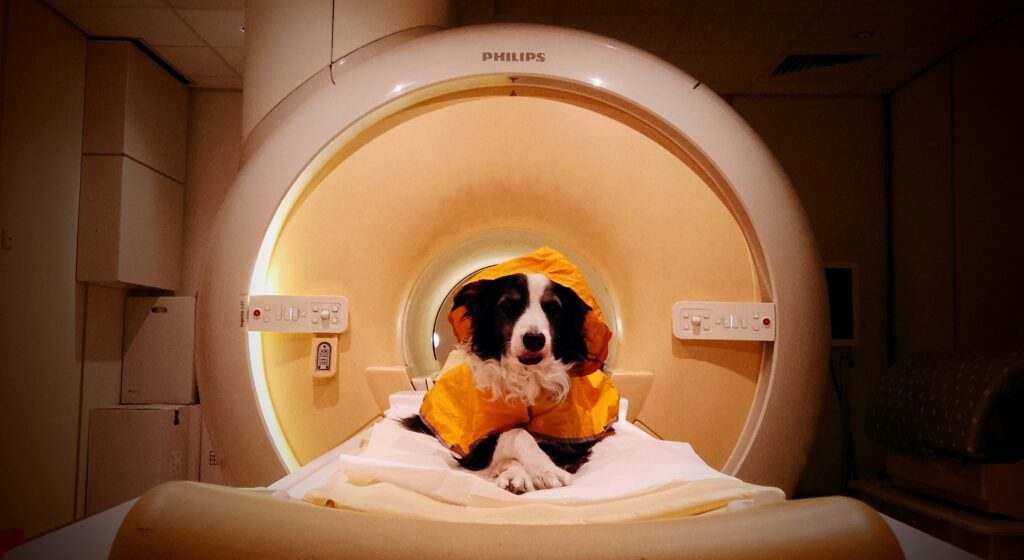
Dogs can distinguish different human facial expressions, including happiness, sadness, fear and anger, according to a study published in the scientific journal iScience. The investigation, which analyzed the brain activity of 12 dogs, found distinct patterns of response to different human emotions, suggesting a more sophisticated ability to interpret the emotional signals of their owners than previously demonstrated.
The researchers, from the University of Vienna and other European and North American institutions, used images of people with different facial expressions and observed the animals’ brain activity through imaging scans.
In the initial phase, eight dogs were exposed to images of unfamiliar people with happy or neutral expressions. The smiling faces activated the temporal cortex and the caudate nucleus, brain regions associated, respectively, with cognitive processing and reward.
The activity recorded in the caudate nucleus is particularly relevant. According to the researchers, it could indicate that happy human faces have an emotional meaning for dogs.
The team then expanded the experiment to 12 animals, showing them images of people who were happy, angry, scared and sad. The analysis of brain activity through machine learning techniques revealed that the dogs did not respond in the same way to the different negative emotions.
Although the brain network associated with happiness showed its own response, allowing easy distinction between smiles and the three negative expressions, a whole-brain analysis also revealed different patterns in response to fear, anger and sadness.
Thus, the study provides evidence that dogs are not limited to distinguishing positive and negative expressions, but are also able to differentiate some specific negative emotions.
The researchers emphasize, however, that this capacity does not mean that dogs feel or interpret emotions exactly the same way as humans. Furthermore, a photograph of a face represents only part of the information that animals use to understand people’s emotional state.
In everyday life, dogs also rely on body language, vocal characteristics, and smell to interpret human signals.
For the researchers, dogs’ ability to interpret human social signals has evolved in a particular way through the domestication process. Unlike primates, which share a common evolutionary history with humans, dogs followed a distinct evolutionary trajectory, developing, during their cohabitation with people, social abilities that allow them to understand and cooperate with us.
The researchers also warn of a limitation of the study: all participating animals were companion dogs, integrated into families. Stray dogs or those living freely face different social environments and may, therefore, process human signals differently.
The team now aims to study how dogs integrate different brain signals to interpret the people around them, as well as compare how human and canine brains process the same emotional signals.