
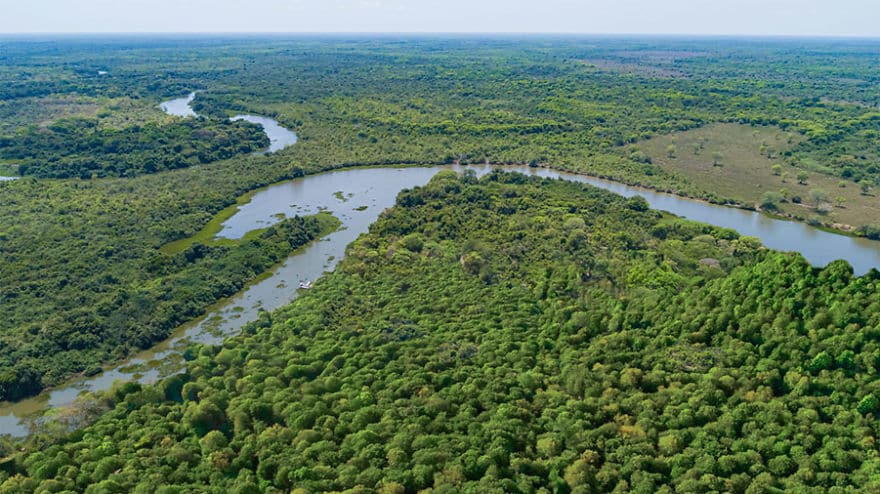
The surface of water-covered area in the Amazon rose again in 2025, after two consecutive years of severe drought, according to data released today by the MapBiomas monitoring network.
Still, Brazil continues to show a trend of decreasing water resources over the last four decades, assessed by the organization that brings together universities, non-governmental organizations and technology companies.
MapBiomas points out that the Amazon accounts for 61.4% of the country’s total surface of water and ended 2025 with an area 2.6% above the historical average recorded between 1985 and 2025.
The largest gains were recorded in the states of Pará, with 142 thousand hectares above the historical average, and in Amazonas, with an increase of 87 thousand hectares.
“The recovery of the water surface in the Amazon in 2025 is a positive sign after two years of severe drought,” said Bruno Ferreira, a researcher with MapBiomas’s Amazon team and Imazon, in a press release.
According to the researcher, the increase is associated with the growth of rainfall relative to the previous year, although the situation remains worrying in the face of the higher frequency of extreme climate events.
“Even with this recovery, the situation remains worrying in the long term, as extreme weather events are increasingly frequent in the region,” he said.
The study highlights that the recovery did not occur uniformly and that 20 Amazonian sub-basins, equivalent to 37% of the total, remained with water surface below the historical average.
According to MapBiomas, this situation particularly affects riverine communities, of which at least half are located up to 50 kilometers from the 12 main rivers of the Amazon.
In contrast, the Pantanal showed the worst result among Brazilian biomes and ended 2025 with water surface 56% below the historical average recorded between 1985 and 2025.
The biome, located in the Brazilian Central-West, accounted for 679 thousand hectares of water surface in 2025, a result 34% higher than 2024, when it recorded 506 thousand hectares during a historic drought.
Still, the Pantanal was the only Brazilian biome that remained below the historical average during all the months of the year, according to the survey.
Mariana Dias, a researcher with MapBiomas’s Pantanal team, assessed that the dynamics of the waters in the Pantanal have changed, and said that the 1980s “were marked by large floods, but since 2019 the region has faced prolonged droughts.”
Across Brazil, the water surface reached 18.2 million hectares in 2025, an increase of 5.3% from the 17.2 million recorded in 2024, but still below the historical average of 18.5 million hectares.
According to the survey, the area covered by water currently accounts for about 2% of the national territory.
Historical analysis reveals a continuous decline in the last decades, moving from an average of 19.86 million hectares between 1985 and 1994 to 17.28 million hectares between 2015 and 2024.
Between the first and last decades analyzed, the accumulated average loss reached 2.6 million hectares.





