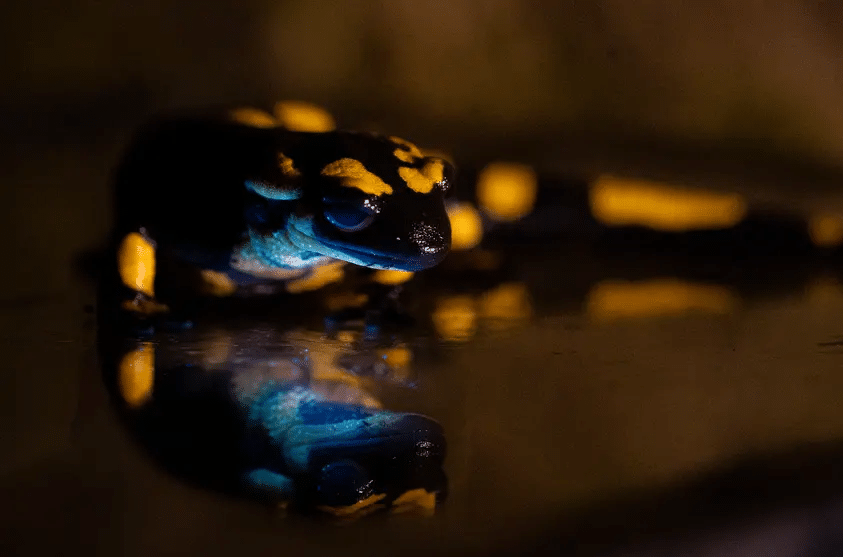
The fire salamander (Salamandra salamandra) is an unmistakable amphibian, its black body speckled with yellow spots. It is a species found in several European countries, including continental Portugal.
Although it is a creature known to many and relatively well studied, a new investigation reveals a hitherto unknown capability: this salamander is capable of absorbing light invisible to the human eye and emitting it visibly, a phenomenon known as biofluorescence.
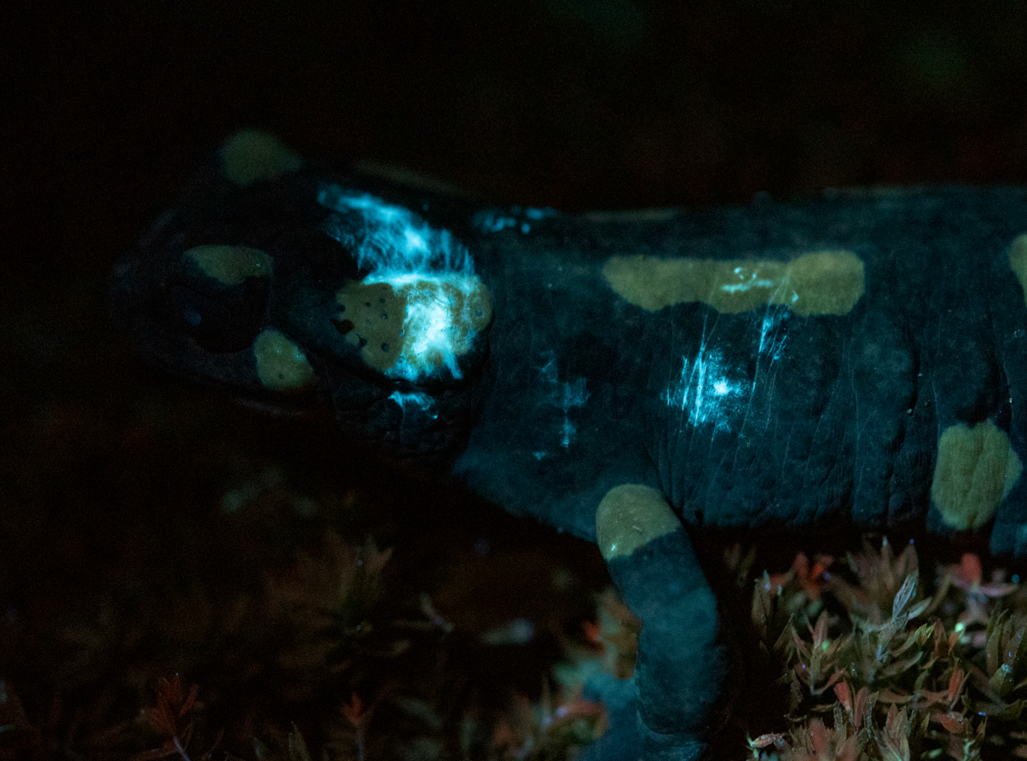
Led by the Institute of Evolutionary Biology of Barcelona and the Max Planck Institute for Chemical Ecology, the work, published in the journal ‘Royal Society Open Science‘, explains that the biofluorescence of the fire salamander is mainly concentrated in the ventral region and along the sides of the body.
According to the researchers, it is generated by skin cells and by the secretions they produce, and these secretions can maintain fluorescence for more than 24 hours after they have been released.
This capacity was discovered after scientists shone ultraviolet light on salamanders in forests in Spain and Germany. When they absorb this type of radiation, which is invisible to the human eye, the chemicals in the salamander’s skin transform them and emit them within the spectrum visible to our eyes. The biofluorescence of the fire salamander displays greenish and bluish hues.
“It is fascinating that a well-studied species still hides phenomena like this,” says Bernat Burriel Carranza, the first author of the study. The researcher from the Institute of Evolutionary Biology of Barcelona notes that the discovery shows that “even the organisms that are most familiar to us can hide secrets that are only revealed when observed with new tools.”
Biofluorescence is different from bioluminescence, because it depends on an external light source, absorbing it and emitting it at another wavelength. Bioluminescent organisms, such as fireflies, on the other hand, emit their own light through chemical reactions that occur in their bodies.
Although it is not yet known exactly for what purposes salamanders use the biofluorescence, the researchers believe it has an important ecological function and have several theories: it may serve to communicate with other individuals of the species, it may help attract mates, or it may be another way, beyond the yellow markings, to warn predators that the animal is toxic and not worth eating.
“It may help salamanders detect one another in nocturnal or particularly dense environments, or function as an additional defense signal,” says Martin Kaltenpoth of the Max Planck Institute, who also co-authors the study.
It is also not yet known which molecules are responsible for conferring fluorescence on the skin secretions of the fire salamanders, but the team believes it might be a molecule not yet found in the animal, even though the chemistry of its secretions has been studied for a long time.
“Identifying it will be crucial to understand its origin and function,” says Salvador Carranza, the principal co-author of the article.
The fire salamander is an endangered species, classified as “vulnerable” on the International Union for Conservation of Nature Red List, with a declining population trend, and threatened by the destruction of its moist habitats, by diseases caused by fungi, and by pressure from invasive species, such as the Louisiana red swamp crayfish.