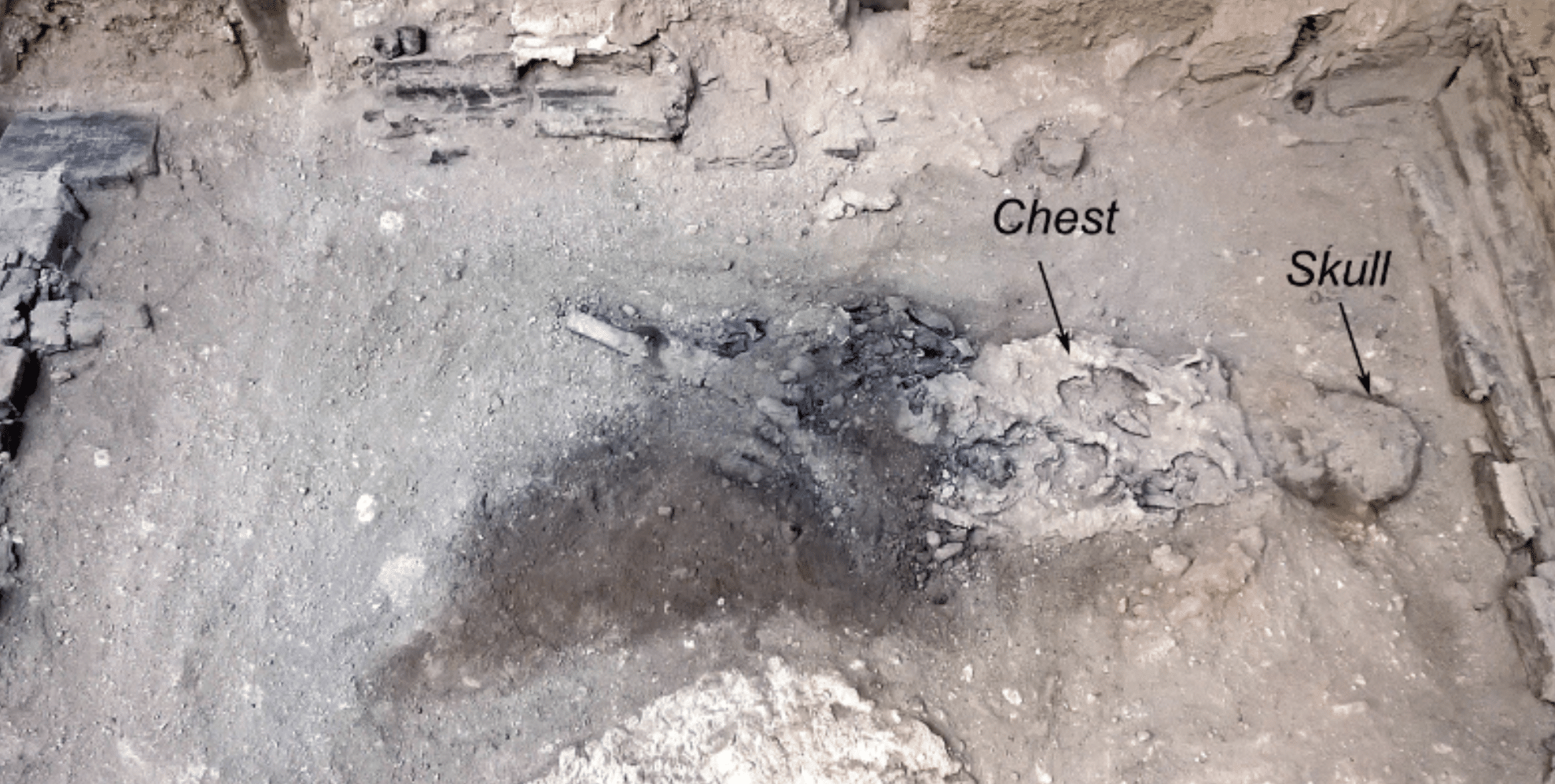
A unique dark-colored organic glass, found inside the skull of an individual who died in Herculaneum during the eruption of Mount Vesuvius in 79 CE, probably formed when the individual was killed by a very hot but short-lived ash cloud.
The conclusion, drawn from an investigation published in the journal Scientific Reports, is based on an analysis of the physical properties of the glass, which is thought to constitute the fossilized brain of the individual.
Glass rarely occurs naturally due to the specific conditions necessary for its formation. For a substance to transform into glass, its liquid form must cool sufficiently quickly to avoid crystallizing when it becomes solid — which requires a large temperature difference between the substance and the surrounding environment — and the substance must solidify at a temperature much higher than that of the surrounding medium.
Consequently, it is extremely difficult for organic glass to form, since ambient temperatures are rarely low enough for water — a key component of organic matter — to solidify. The only suspected natural organic glass was identified in 2020 in Herculaneum, Italy, but it was not clear how this glass formed.
Guido Giordano and colleagues analyzed fragments of glass recovered from inside the skull and the spinal cord of a deceased individual from Herculaneum, found lying in bed at the Collegium Augustalium. The results of the analysis — which included obtaining images by X-ray and electron microscopy — indicated that, for the brain to become glass, it would have had to be heated to at least 510 degrees Celsius before cooling rapidly.
The authors note that this could not have happened if the individual had been heated only by the pyroclastic flows that buried Herculaneum, since the temperatures of those flows did not exceed 465 degrees Celsius and would have cooled slowly.
They therefore conclude, based on observations of modern volcanic eruptions, that a superheated ash cloud that dissipated rapidly was the first mortal event during the Vesuvian eruption. Their theory is that this event would have raised the individual’s temperature above 510 degrees Celsius, before cooling rapidly to ambient temperature as the cloud dissipated. The bones of the skull and spine presumably protected the brain from complete thermal rupture, allowing the fragments to form this unique organic glass.