A study published recently in the journal ‘Fossil Record’, which involved a Portuguese researcher, reveals the evolution of amphibians and reptiles on the Iberian Peninsula 16 million years ago.
Vicente D. Crespo, a paleontologist at the Faculty of Science and Technology of NOVA University of Lisbon (NOVA FCT) and at the Lourinhã Museum, is the principal co-author, and Rafael Marquina Blasco, from the University of Valencia, is the first author.
The study presents what NOVA FCT says is “the most comprehensive analysis to date of the reptiles and amphibians [the group also known as the herpetofauna] from the Lower Miocene geological period in the Ribesalbes-Alcora region, in Spain.”
For Vicente D. Crespo, this work aims “to help fill one of the largest knowledge gaps about the evolution of amphibians and reptiles on the Iberian Peninsula, being another step in reconstructing the Iberian Miocene ecosystems, now integrating these species with the numerous studies previously conducted on fossil mammals from the Ribesalbes-Alcora Basin.”
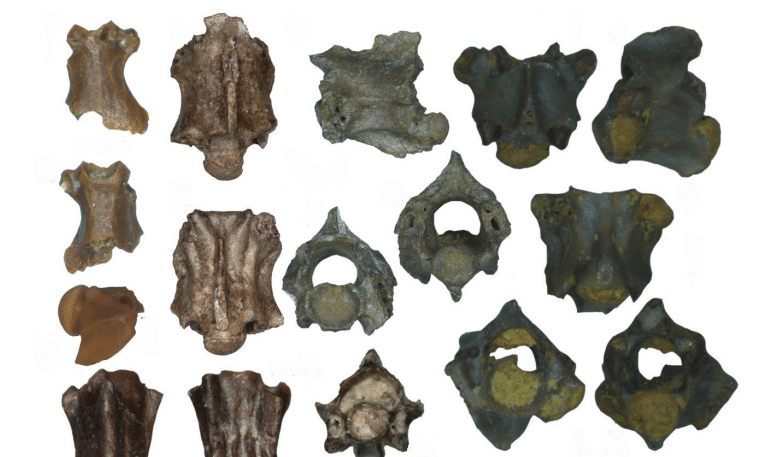
The investigation is based on the analysis of 4,690 fossil remains collected from 42 localities, which allowed reconstructing the ecosystems that existed about 16 million years ago, providing new clues about the origin of the current European communities of reptiles and amphibians.
Twenty-one taxa of amphibians and reptiles were identified, including salamanders, frogs, crocodiles, turtles, lizards, and snakes. The results show that many of the lineages now part of the European fauna were already established during the Lower Miocene, “a crucial period for the formation of modern ecosystems,” explains the institution.
Considered one of the most relevant results of this investigation is the possible identification of the genus Pyrenasaurus, previously known only from Eocene deposits. If this identification is confirmed, the researchers explain, the record will significantly extend the evolutionary history of this group, suggesting greater ecological stability in certain regions of the Iberian Peninsula than previously thought.
The authors used paleoecological methods based on the ecology of amphibians and reptiles to estimate the climatic conditions of the era. The analyses indicate that the region now lying in the eastern part of Spain was, in many periods, much wetter than today, with precipitation levels generally higher than current levels, alternating between wetter phases and relatively drier periods. This finding aligns with earlier studies conducted on the fossil mammals of the same basin.