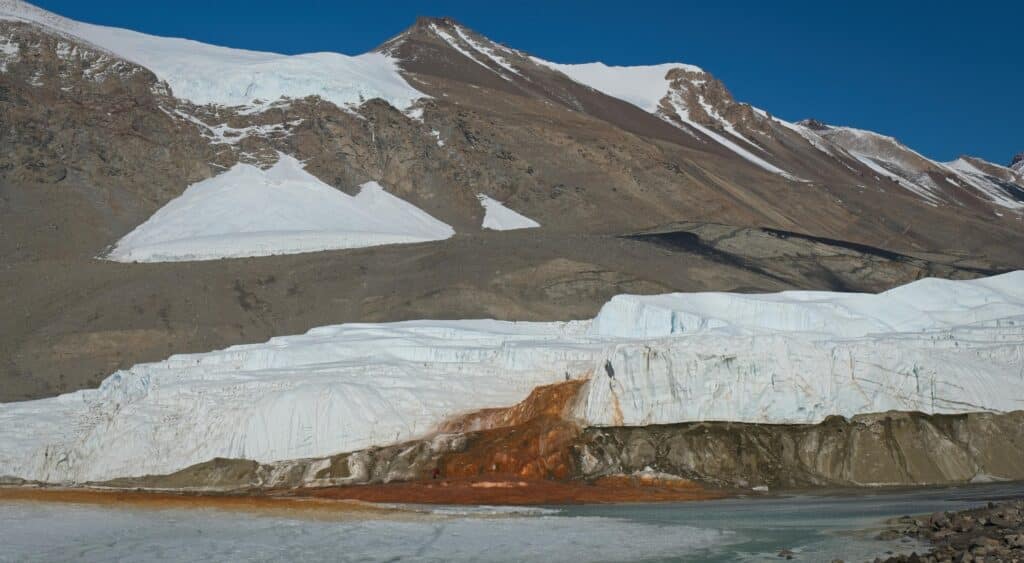
The mysterious Blood Falls of Antarctica, known for the intense red coloration of the water that flows from the edge of Taylor Glacier, may be traces of a time when the sea covered that region of the icy continent. The conclusion comes from an international study published in the scientific journal Nature Geoscience.
Blood Falls, located in the McMurdo Dry Valleys, releases an iron-rich brine that emerges from within the glacier. When it comes into contact with the oxygen in the atmosphere, the iron oxidizes, giving the water its characteristic reddish hue.
Although the origin of the color has been known for several years, the source of the saline water remained to be clarified.
To investigate this question, a team of researchers analyzed 167 samples of water, sediments and air collected in the region. Using genetic analysis techniques, they identified bacteria, fungi and other microorganisms present in the different samples.
The results revealed that the organisms found in the red ice, in the mud and in the sediments near Blood Falls are strongly associated with marine environments. In contrast, the remaining zones of the Dry Valleys were dominated by microorganisms typical of terrestrial and freshwater environments.
According to the researchers, this difference constitutes strong evidence that the brine beneath the glacier originated from seawater.
The hypothesis is that, during a warmer period in the past, the ocean invaded Taylor Valley. Later, as sea level dropped and the glacier advanced, this saltwater became trapped beneath the ice, where it remained isolated for thousands—or even millions—of years.
The authors also consider it unlikely that marine microorganisms reached the site recently by wind, reinforcing the idea that they represent an ancient biological community preserved in the frozen subsurface of Antarctica.
In addition to helping clarify the region’s geological history, the study could contribute to a better understanding of how microbial communities manage to survive for long periods in extreme environments, offering new clues about the evolution of polar landscapes and about the limits of life under conditions similar to those on other planets.