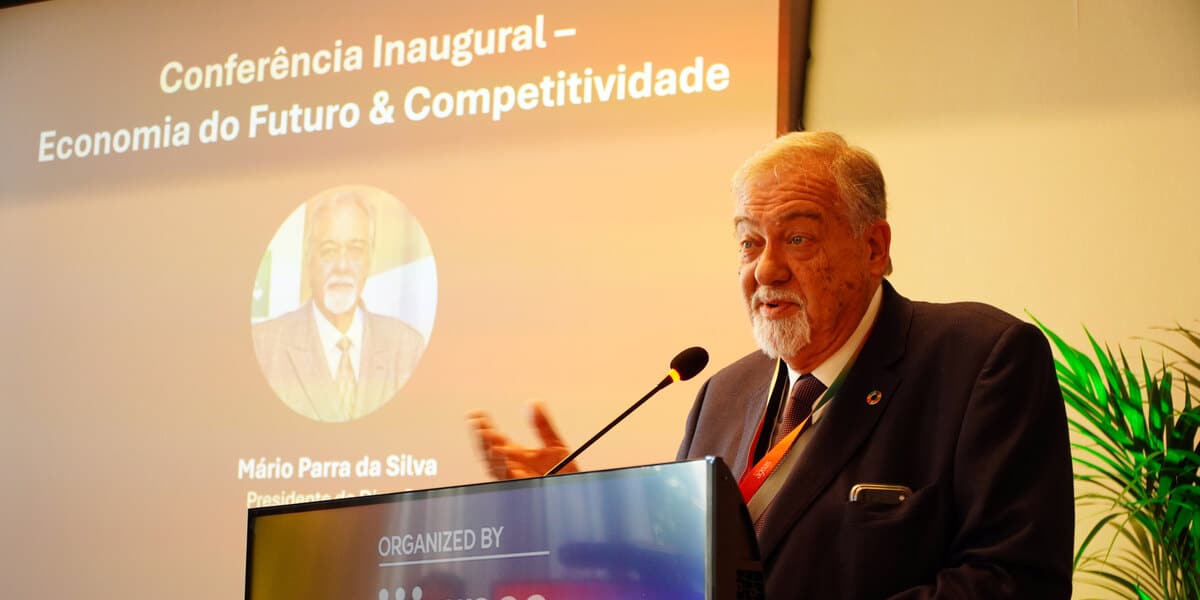
The choice of the theme “Future Economy and Competitiveness” for the Week of Social Responsibility, organized by APEE – Portuguese Association of Business Ethics, was not initially consensual. For Mário Parra da Silva, president of the APEE board, the relationship between social responsibility and competitiveness is, however, inescapable at a moment of profound economic, political and social transformation.
“We are at a turning point in history. I do not want to talk about the events in Paris, about the country, or about Germany, nor about Volkswagen’s five billion euros of losses. There are so many things that show we are at the end of an era. The world we know is ending and another is being born. People continue to live, families continue to exist, companies continue to produce. It is necessary to carry on, but with a different organization. The current paradigm does not serve.”
The reflection stems from a concern about Europe’s ability to guarantee future prospects for its populations and to maintain an economy capable of creating wealth. The president of APEE considers that European competitiveness is under threat and that the answer cannot be limited to the production of rules.
“People, all across Europe, are revolting because they do not see a future. They do not see a future for the youth, they do not see a future for families, they do not see a future in many respects. Our industries will probably not survive to a large extent,” he stated at the opening conference.
In his analysis, other economic models demonstrate greater efficiency, while the European Union continues to ignore an essential issue for its economic sustainability.
“The Chinese model is much more efficient. The American model as well, the European one, not. But we want it to be. The European Union blatantly ignores the issue of competitiveness and continues to produce standards. But it is not standards that Europe needs. It needs a future economy that is competitive in order to distribute wealth, namely to build houses.”
However, competitiveness does not represent a departure from business ethics. On the contrary, Mário Parra da Silva believes that ethics must remain as a reference in an economy subject to profound changes.
“The Europe of the future, that competitive Europe, has one thing in common with the current one. It is called ethics. Because what is immutable, what does not disappear, is our sense of whether we are doing good or not. That is why APEE is so sensitive to issues of competitiveness. Because if we are not competitive, we will all end up clobbering one another, possibly even in internal civil wars. I cannot hide a certain degree of fear. Fear of what might happen to immigrants, for example. Then, because in the United States, there was someone who suggested that women were unfit to vote. The first country that granted women the right to vote, in fact, could be the first to revoke it. I consider that an absolutely absurd threat, but it may find its way.”
In a context of uncertainty, the leader assigns to companies a central role in responding to economic and social challenges.
“In this crazy world, companies will react as needed to produce in the coming year. Companies are our hope. This is not a moment of great joys; it is the moment for each person to think about their rights. At APEE, we will not stop defending business ethics. And the expression of ethics within organizations is to do well what is done. Do good and add value,” he urged, addressing the business fabric.
Sustainability and competitiveness are part of the same business
The integration of sustainability into corporate strategy was one of the dimensions highlighted by Inês Martins Rodrigues, Director of Sustainability and Corporate Affairs for the Ageas Portugal Group and host this year, who considers the separation between these two areas to be outdated.
“Sustainability does not live on the margins of business; it is an integral part. For a long time, sustainability and competitiveness were two faces of the same coin, not to be touched. Today, that notion no longer makes sense. Sustainability means understanding risks, means anticipating changes, adapting products and services, means innovating, means protecting the business and, of course, continuing to create value. This is also competitiveness. In the Ageas Group we have embraced this motto, particularly in our sustainability strategy. And competitiveness is built hand in hand with responsible innovation, with the ability to respond to real challenges and with a genuine commitment to our people and to our customers.”
The official believes that the economy of the future also depends on the capacity of organizations to work together, listening to different perspectives and involving all stakeholders in the search for solutions.
“We are not talking about a reality very distant; we are talking about choices that begin today. No company, no institution and no sector will be able to respond alone to the scale of the challenges ahead. The economy of the future will need to listen to all stakeholders. There must be more collaboration, more capacity to experiment and more courage to do things differently, including the players from the private sector, the public sector, academia and, of course, the community. We need to build the solution together.”
Lisbon and shared responsibility in the sustainable transition
The collective dimension of sustainability was also present in the intervention by Vasco Anjos, Councillor of the Lisbon City Hall, who highlighted the role of the various partners in achieving the city’s climate objectives. The realization of the climate contract, he stressed, does not depend exclusively on the municipal authority, but on the involvement of all stakeholders.
“The climate contract is not the property of the City of Lisbon, but of all stakeholders. In 2030, we want to meet the criteria. All partners will make Lisbon a better city. We are creating the sustainability area for good governance.”
Artificial intelligence and the future of work
Technological transformation represents another major challenge for the economy and for society and was not forgotten on the first day of the conference. João Safara, executive director of ISQ, drew attention to the consequences of the increasing use of intelligent systems, capable of deeply altering the organization of work and the distribution of wealth.
“Smart machines are increasingly close, we are using more silicon beings. We, carbon-based beings, learn slowly, we err, we think a lot, we get tired, we age, we die. Silicon beings are always learning, they do not tire, they do not die, they can become obsolete, but they do not die and they have an scale with zero marginal cost. This will bring about significant social changes. There will be fragility of the middle and lower classes; youths will have difficulty using what they learned. There will be less work, more leisure time, mass layoffs, strong dependence on the Welfare State. In terms of capital, corporate profits will be colossal, and today we see Meta, Google. AI will, above all, transform work, capital, hedging and arbitrage into capital and arbitrage. And it is no accident that Europe is experiencing constant street revolutions. People have already begun to see the vertex where they stand. Those who are not capitalists will see their income fall quite a bit.”
The intervention highlighted a central question for the social responsibility of organizations: how can we ensure that the productivity gains associated with artificial intelligence do not deepen economic and social inequalities? The transformation of work, the concentration of capital and the need to adapt skills require a reflection that goes beyond the technological dimension and considers its effects on people.
Universities, ethics, and inclusion
Preparation for change also passes through higher education. José João Mendes, President of the Board of Egas Moniz School of Health & Science, argued that universities should take an active role in transforming society.
“It is important for us to be authors of change. The University is also undergoing change and is being questioned about its own existence. There is a lot to do, and the competitiveness of the future rests on ethics, people and sustainability. Higher education is one of the pillars of assurance. There is here a great challenge posed by AI. All students and teachers use it. It is not feasible to prohibit it; we must empower people, invest in digital literacy. Those who use AI have to say so,” he stated in his speech.
The use of artificial intelligence in universities raises challenges related to digital literacy, transparency and responsibility. For the academic, the answer must lie in empowering students and teachers, preparing them for a conscious use of these tools.
Inclusion is another dimension of the social responsibility of academic institutions. The diversity present on the Egas Moniz campus constitutes, according to the official, an example of the importance of promoting understanding among different communities.
“On our campus, we have 56 nationalities. Surely, all kinds of religion exist and everyone must understand each other, with learning as the focus. And that makes us look at inclusion. Europe needs immigration, and if it needs it, it must include. Universities can lead by example; they must train and practice social responsibility.”
The interventions of the first day of the Week of Social Responsibility highlight different dimensions of the same transformation. Economic competitiveness, corporate sustainability, technological evolution and social inclusion are interdependent challenges that require new forms of organization and collaboration.
The discussion promoted by APEE precisely seeks to broaden the debate on the responsibility of organizations, at a moment when decisions taken now will have direct consequences on the economy and society in the coming years.