
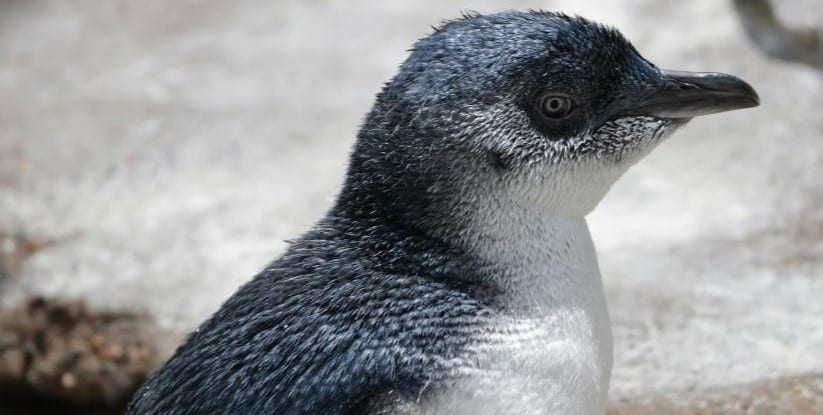
Researchers from Curtin University used cutting-edge imaging technology to elucidate the auditory sensitivity of Australian little penguins and the dangers of marine noise pollution.
Supported by the Westport program of the Western Australian Marine Science Institution, the study is the first to detail how Australian little penguins, also known as fairy penguins, perceive sound both in the air and underwater.
The study’s lead, Chong Wei, from Curtin’s Centre for Marine Science and Technology, explains that Australian little penguins are particularly vulnerable to human-made noise, since their habitats frequently overlap with shipping routes, recreational activities, and coastal developments.
“Ocean noise pollution is increasing steadily, which is particularly concerning for Australian little penguins, whose populations are declining significantly,” says Wei.
“We know very little about the impact of this noise on penguin hearing. To address this, we created 3D digital models using micro-CT scans of the heads of three Australian little penguins that died of natural causes on Garden Island to simulate what they can hear at different frequencies,” he reveals.
“Frequency units are called hertz (Hz), and these 3D models revealed that little penguins can hear sounds across a wide range from 200 to 6000 Hz underwater, similar to other diving birds such as the cormorant,” he adds, noting that “ship noise typically ranges from 20 to 10,000 Hz, as does pile driving.”
Co-author Christine Erbe, from Curtin’s Centre for Marine Science and Technology, notes that the study’s findings are important for marine conservation efforts.
“Continuous exposure to elevated noise levels from passing vessels and coastal construction may increase stress and interfere with little penguin behaviors, such as feeding,” says Erbe.
“Understanding its hearing range helps us identify noise frequencies potentially harmful, and the results may serve as a basis for management plans aimed at reducing the impact of noise pollution,” she concludes.
The study titled “Sound reception and hearing capabilities in the Little Penguin (Eudyptula minor): first predicted in-air and underwater audiograms” was published in the Royal Society Open Science journal.