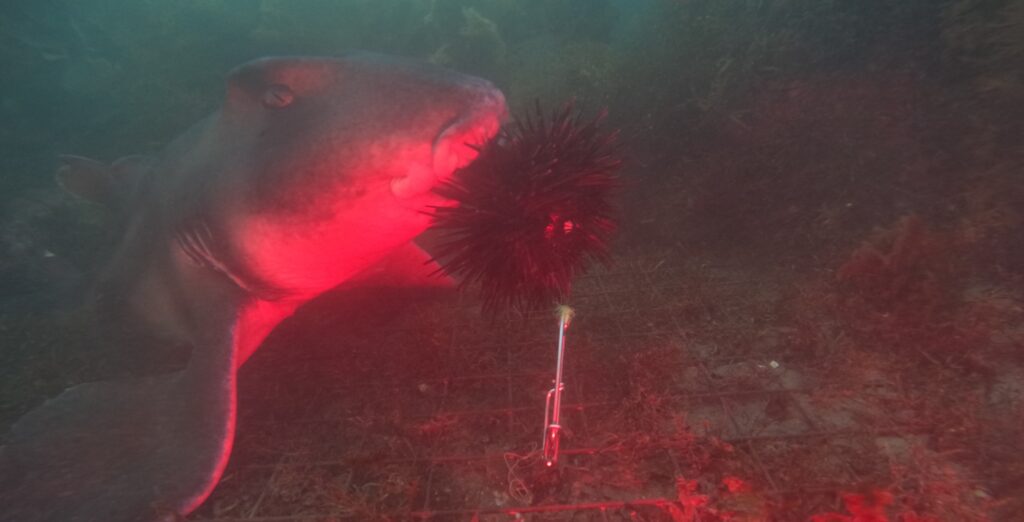
In a new study to understand how lobsters prey on sea urchins, a camera was installed in a lobster burrow and sea urchins were strategically placed.
Surprisingly, most sea urchins were eaten – not by lobsters – but by sharks. This fact challenges the prevailing beliefs that lobsters are the main predators of sea urchins, and it is important for helping to inform the sea urchin management strategies that are intended to protect reefs.
“Sharks are overlooked predators of sea urchins in NSW, while the role of lobsters appears to be smaller than expected. It is important to note that sharks readily handle very large sea urchins!” says the principal investigator at the University of Newcastle, Jeremey Day.
“This experiment was originally designed to show how lobsters feed on sea urchins, but sharks surprisingly entered and ate the majority (45%) of the tethered urchins, while lobsters ate few (4%),” he explains.
“It is thought that spiny lobsters are the ‘key’ predators of sea urchins, which control their abundance, while sharks are not normally considered in urchin predator models,” he adds.
Methodology
Jeremy explains that they tethered 100 sea urchins directly to a lobster den (that is, the place where lobsters live) in Wollongong over 25 nights. “Tethering” is when the sea urchins are surgically restrained to remain available for predation during the night and to be visible to our cameras, he explains, noting that they used a filtered red light to film the experiments because invertebrates do not like the white light spectrum.
Until now it was thought that there were few or none predators capable of dealing with very large urchins.
“In this study, we report the existence of a predator of urchins little considered among Port Jackson sharks and crested sharks, and we determined that the effect of lobsters on urchins in nature is smaller than previously thought. This is important because long-term efforts to control the number of urchins, ensuring the number of predators, have not had the expected effect in NSW, despite protections of > 20 years.”
“This experiment provides a plausible answer, since the lobsters generally appeared uninterested in eating urchins, and it also increases the complexity of the model, as sharks emerged unexpectedly as the predator that ate the majority of urchins. We confirm that the range of predators that eat urchins is broader than traditionally thought,” concludes Jeremy Day.