
An international team of researchers identified fossilized red blood cells and heme molecules in the bones of a 115-million-year-old dinosaur found in northeast Brazil. The discovery, considered unprecedented, opens new possibilities for studying the physiology, metabolism, and activity levels of animals that disappeared millions of years ago.
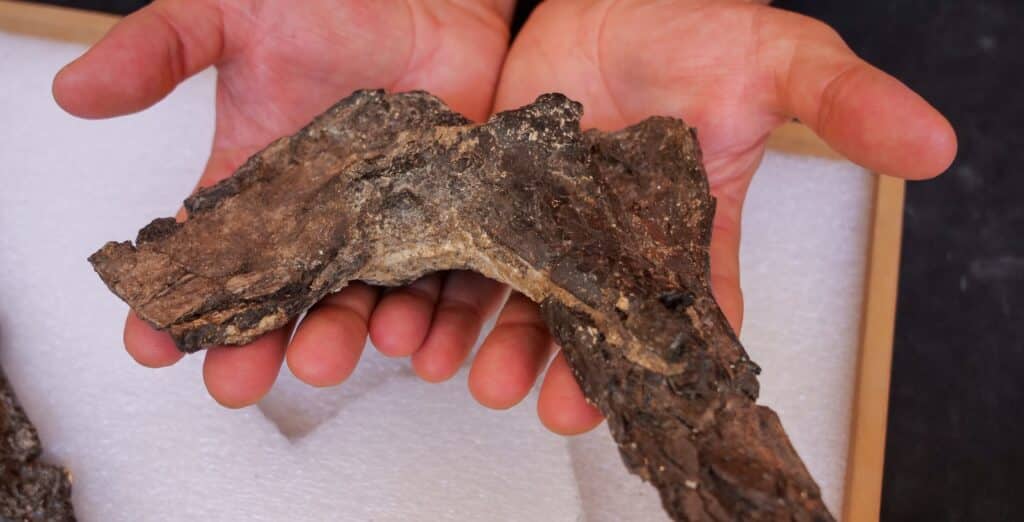
An international team led by Curtin University in Australia has uncovered unequivocal traces of fossilized red blood cells in a 115-million-year-old dinosaur. The remains were identified in limb bones of an Aratasaurus museunacionali, a theropod dinosaur whose fossils were found in northeast Brazil.
The study, published in the scientific journal Proceedings of the National Academy of Sciences (PNAS), identified mineralized cellular structures and preserved heme molecules inside the vascular channels of the bones. He me is the component of hemoglobin responsible for transporting oxygen in the blood, and its identification chemically confirmed the presence of fossilized blood remnants.
Although previous investigations had identified structures similar to possible red blood cells in fossils, this is the first time that scientists have chemically demonstrated the presence of molecules derived from hemoglobin within these cells.
“Detecting intact heme molecules, derived from red blood cells that are 115 million years old, is astonishing: it truly constitutes a landmark discovery,” says Kliti Grice, distinguished professor at Curtin University and the study’s lead author.
The researcher notes that the results not only extend the known fossil record of blood remnants but also allow direct access to the molecular biology of extinct animals.
“Not only does it broaden the known fossil record of blood, but it also provides a direct molecular window into the physiology of long-extinct animals, allowing us to understand them better and to know the world in which they lived,” she adds.
A mineral acted as a time capsule
One of the most surprising aspects of the discovery is how these structures managed to survive for so long. The red blood cells were mineralized with hausmannite, a mineral that would have contributed to preserving the cellular structures and their biomolecular components, including collagen amino acids.
The researchers believe that the exceptional preservation could be related to the rapid burial of the dinosaur after death, in an environment with low oxygen and rich in microorganisms. These conditions would have favored the preservation of the biological traces over millions of years.
The discovery challenges one of the established ideas about the limits of molecular preservation in the fossil record: that certain biomolecules, such as those associated with hemoglobin, would not withstand geologic time scales of such length.
“These findings challenge long-standing assumptions that certain biomolecules, such as hemoglobin, cannot survive such extended geologic periods,” notes Kliti Grice.
New clues about the life of dinosaurs
In addition to helping understand fossilization mechanisms, the results could open new avenues of investigation into the evolution of blood, metabolism, and activity levels of prehistoric animals.
The possibility of recovering molecular information directly from fossils could allow paleontologists to go beyond analyzing skeleton anatomy and study aspects of the biology of species that disappeared millions of years ago.
Martin Van Kranendonk, director of Curtin University’s School of Earth and Planetary Sciences, believes that the research could have implications that go beyond paleontology, notably for astrobiology and the search for traces of ancient life in other locations in the Universe.
The work also involved researchers from the Japan Agency for Marine-Earth Science and Technology, the National Museum of Brazil, the Regional University of Cariri, and Johns Hopkins University in the United States.
The research was funded through a Laureate Fellowship awarded in 2021 by the Australian Research Council to Kliti Grice.