

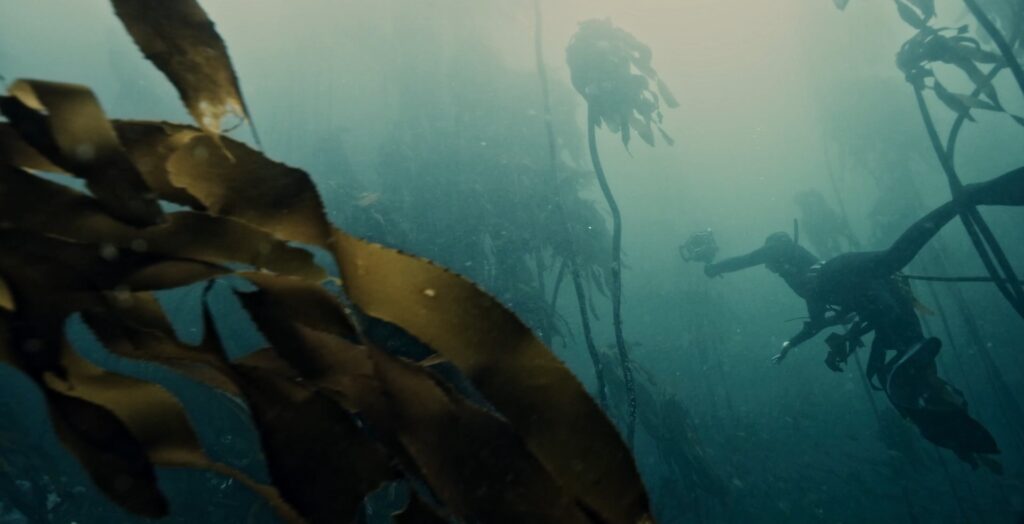
At the end of the first year of startup, the country’s first open-sea algae regenerative farm has already found more than 200 types of marine life in the farm area and in nearby zones. The farm spans 22.5 hectares, and the ambition is to reach 200 hectares, equivalent to about 280 football fields. The results were presented on National Day of the Sea by the Hope Zones Foundation at the second Cultivating Hope Summit, organized in partnership with the Nazaré City Council, which brought together national and international experts, researchers, investors and companies at the Nazaré Cinematheatre; this was announced in a press release.
According to the same source, the project works on three fronts. First, to create on the seabed a habitat that functions as a nursery for juvenile fish. Then, to assess how much carbon the algae can help sequester. In a second phase, to transform part of the algae into agricultural biostimulants.
The preliminary results were obtained by the scientific team led by João Franco, a marine biologist from the University of Leiria – Oeste. The scientists studied the farm’s area and other nearby zones without algae, in order to compare. This is the baseline: in the coming years, they will monitor whether marine life increases where the algae grow. The team is also measuring how much carbon remains stored on the seabed, to understand, over time, if the algae help remove it from the atmosphere.
“In this first year, we found more than 200 species of marine life in the farm area and in the surrounding zones. Now we know what exists there and we can monitor what changes. We want to prove with data that the algae help life return to the sea, before asserting it,” says João Franco.
The farm is a philanthropic project, funded by donations. Its main objective is to restore life to the sea and reestablish the services that the marine ecosystem naturally provides, such as shelter for fish, climate regulation and water quality. Production comes second. Nevertheless, the first year allowed a first harvest of about 300 kilograms of algae, dried in an artisanal way at the Nazaré Port of Shelter. In a second phase, part of them could be transformed into an agricultural biostimulant, a natural fertilizer that revives an old practice along the Portuguese coast, and into other biologically based products.
“A year ago, we placed the first algae in Nazaré’s sea. Our objective is to restore life to the ocean, and today we know that this sea is full of it. If, in addition, the algae can reach land as a natural fertilizer, we create value for those who live from the sea without taking anything from the ecosystem. The next step is growth, and our ambition is to reach 200 hectares, always based on what science shows us,” says João de Macedo, President and co-founder of the Hope Zones Foundation.
“We believe that Nazaré’s future also depends on the ability to diversify its economic base, go beyond traditional activities and create conditions for the development of new projects linked to innovation, research, technology and the sustainability of the oceans,” says Serafim António, President of the Nazaré City Council.
Hope Zones Foundation aims to involve more fishermen in a supplementary activity to fishing, which could also attract young people to the sector. For the foundation, the fishing community is part of the solution to regenerate the sea. In the afternoon, participants visited the farm by boat.
The project is developed in partnership with the Nazaré City Council and Nazaré Qualifica, with scientific support from the University of Leiria – Oeste, through MARE, and counts on the support of Patagonia, the World Surf League and Indico Capital’s Blue Fund.




