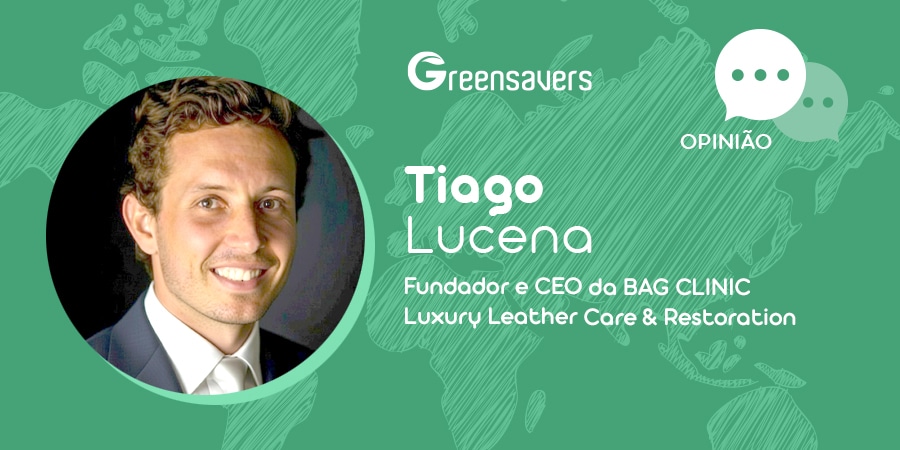
By Tiago Lucena, Founder and CEO of BAG CLINIC — Luxury Leather Care & Restoration
For decades, we have grown accustomed to associating consumption with replacement. When a bag showed wear, a pair of shoes faded in color or a wallet began to reveal signs of daily use, the most immediate response was to buy a new piece. Today, this mindset is beginning to change.
The traditional three Rs — Reduce, Reuse and Recycle — have become essential principles of the circular economy. But there is a fourth R that deserves greater prominence: Repair.
In fact, repair should come before recycling. Recycling presupposes that a product has reached the end of its useful life; repair precisely aims to prevent that from happening. Cleaning, preserving, repairing, or restoring a piece allows extending its use for several years, reducing the need to produce and buy a new item.
This shift is particularly visible in the luggage, wallets, footwear and accessories sector. More and more consumers seek specialized services able to recover pieces from luxury brands, but also mid-range items whose quality, usefulness or sentimental value justifies a second life.
A piece is not just an object
A bag, a wallet or a pair of shoes are rarely merely functional objects. They can represent an aesthetic choice, a personal achievement, a special gift, a memory or part of the identity of the person who uses them.
In higher‑quality pieces, this dimension becomes even more evident. The design, the leather, the hardware, the stitching, the finishes and even the way the item ages are part of its identity. Replacing it does not always mean finding something truly equivalent.
Therefore, restoration should not mean indiscriminately turning a used piece into a seemingly new one. A good intervention should respect the original construction, preserve its elements whenever possible and act only to the extent necessary.
There is an important difference between restoring and decharacterizing. The use of inappropriate products, incompatible materials or irreversible alterations can compromise the authenticity of the piece and even reduce its value. Restoration requires diagnosis, knowledge of materials, specialized work and respect for the article’s history.
Care also means preserving value
Regular maintenance can make a significant difference in the longevity of a piece. Accumulated dirt, leather dehydration, humidity, improper storage and small ignored damages tend to accelerate its degradation.
A seam that begins to open, a worn edge or a weakened handle may seem like minor problems. When not corrected promptly, they can transform into structural damages more difficult and costly to resolve.
Technical cleaning, proper hydration, color restoration and preventive repair help preserve not only the appearance but also the integrity and functionality of the piece. In the case of certain items, preserving the original materials, hardware, shape and finishes also contributes to maintaining their commercial value.
The growth of the second-hand market has reinforced this reality. A quality bag or accessory can be used, preserved, resold and circulate among different owners. The better the care, the higher the likelihood it will remain useful and valued.
From a culture of discard to a culture of care
The circular economy does not depend solely on large industrial decisions. It is built through daily choices as well: taking care of what we already have, repairing before replacing and favoring products designed to last.
The production of fashion and accessories involves raw materials, water, energy, chemicals, packaging and transport. Every time we extend a product’s useful life, we delay the production of its replacement and reduce the pressure associated with ongoing consumption.
This does not mean that all pieces should be restored at any cost. It is necessary to evaluate the quality of construction, the condition of the item, the price of the intervention and the additional usable time that could be recovered. But this analysis should be done before concluding that buying new is the only solution.
Many items are discarded not because they have reached the end of their life, but because they have lost their shine, show stains, have faded color or require localized repair. In many of these cases, there is still substantial material, functional and emotional value to recover.
An industry in transformation
The growing demand for these services is also transforming the traditional repair sector. Craft knowledge remains indispensable, but it now coexists with more specialized areas: leather and suede treatment, interior and exterior cleaning, color restoration, repair of straps and handles, reconstruction of components, intervention in hardware and restoration of delicate materials.
This work requires increasingly technical knowledge. It is not enough to apply a cleaning product or to mask a wear mark. It is necessary to correctly identify the material, understand the original treatment and anticipate its reaction to each intervention.
The true luxury perhaps no longer lies only in the act of buying. It also lies in the ability to choose better, to care for what one has and to preserve what was designed to last.
Repairing adds value to specialized work, keeps materials in circulation, protects the consumer’s investment and reduces dependence on a model based on constant replacement.
Reduce, reuse and recycle remain fundamental principles. But before we give up on a piece, we should add one more question: is it still possible to repair?
More and more, the answer will be affirmative.