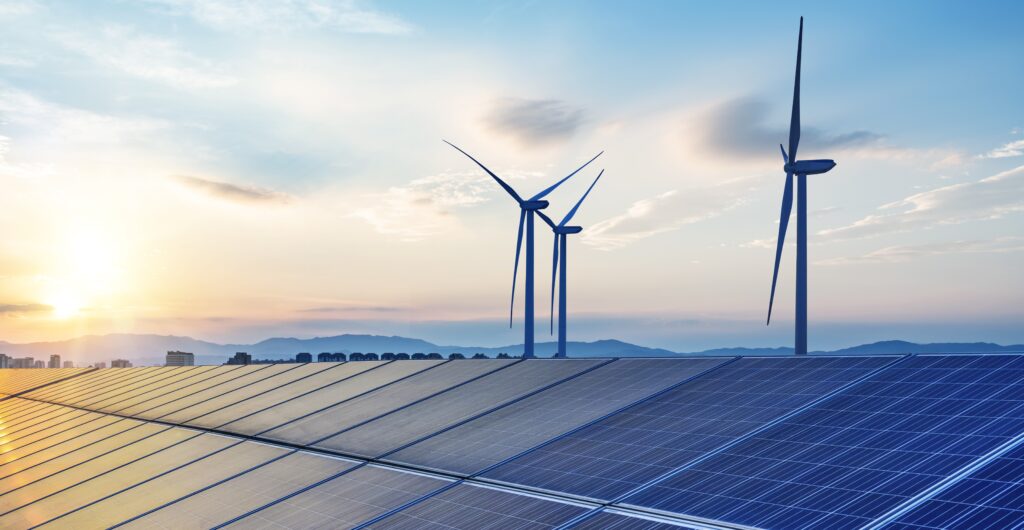
Electricity production in Portugal from renewable sources accounted for 75% of the total between January and July, a year-on-year decline of three percentage points, according to a bulletin released by APREN – the Portuguese Association of Renewable Energies.
“Analyzing the cumulative total of the first seven months of the year (January to July 2026), renewable incorporation into electricity production reached 75%,” a performance that “puts Portugal in fourth place among the European countries analyzed with the highest share of renewables in generation. It ranked only behind Norway (97.3%), Denmark (94.3%), and Austria (78.9%).
According to the same data, “694 non-consecutive hours were recorded in which renewable production was sufficient to meet the entire electricity consumption in Continental Portugal, equivalent to about 29 full days,” APREN said.
In July, 70.5% of the electricity produced in Continental Portugal originated from renewable sources, up 22 percentage points, a figure corresponding to 2,554 GWh [gigawatt-hours] out of a total of 3,611 GWh generated during the month, APREN said.
According to the association, the month of July “was marked by a remarkable achievement for the national energy sector,” as solar photovoltaic energy led electricity production, accounting for 25.8% of the total generation mix and standing out compared with other sources.
Hydropower “occupied the second position, with 21%, followed closely by wind energy, with 17.7%.”
The association revealed that in the electricity market, the average MIBEL price in Portugal stood at 57.3 euros per megawatt-hour in the first seven months, “positioning the country among the markets with the most competitive electricity in Europe.”
According to APREN, “this context records an average decrease of 10.0% compared to the price in 2025.”
The data from the association also indicate that between January and July, “renewable production allowed Portugal to avoid importing 667 million euros in natural gas and 374 million euros in electricity,” while saving 423 million euros in CO2 emission allowances.
APREN also indicated that by the end of June 2026, “renewable sources already accounted for 79.5% of the total installed capacity in Portugal,” highlighting that since 2016 renewable capacity has increased by 9,143 megawatts, a growth of 68.2%.
The bulletin also reported on the situation in the autonomous regions, noting that in Madeira, “electricity from renewable origin represented 46.1% of accumulated electricity generation in the first six months of the year.”
In the Azores, renewable incorporation stood at 31.5% of the total generated during the same period, APREN stated.