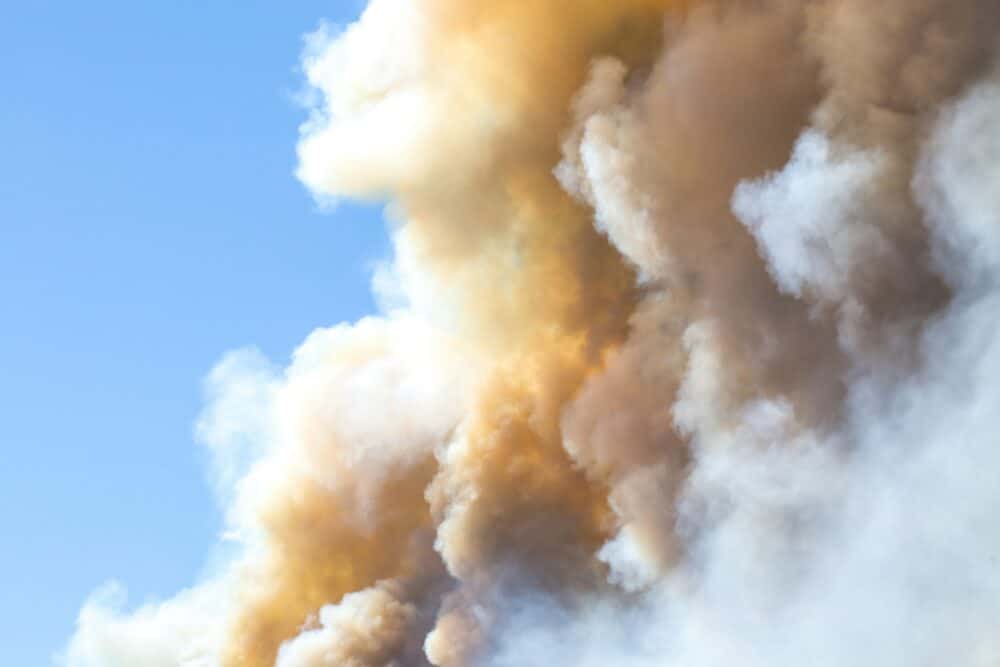
Fires that are more frequent, longer-lasting, and more destructive are one of the most visible effects of climate change. The impacts of the dark clouds of smoke and ash go far beyond the area where the fire occurs, potentially extending for hundreds of kilometres.
Several studies have already pointed to the negative effects on human health of the air pollution generated by wildfires, including in unborn babies. Now, a new investigation reveals another facet of these phenomena.
A team of researchers led by the University of Utah (United States of America, USA) sought to understand how the particles released by fires affect ecosystems, whether they confer any benefit or, on the contrary, are harmful.
Focusing on the United States, the scientists analyzed data from 2014, 2020 and 2022 on days when the sky was smoke-covered and on rainy days. Since they were interested in looking specifically at smoke-affected rain, they cross-referenced the data to identify days when smoke and rain occurred at the same time.
Rainy days with smoke accounted for, on average, between 1% and 5% of the years analyzed, and the researchers noted, in this line of inquiry, that this set of days was responsible for providing up to 30% of the annual amount of nitrogen and phosphorus that enters ecosystems via rain.
Data from analyses of rainfall samples collected by the United States National Atmospheric Deposition Program (NADP), which brings together public entities, universities, companies and non-governmental organizations, show that nutrients such as calcium, magnesium, sodium, potassium, sulfate, nitrate, chloride, ammonium and orthophosphate were deposited in much larger quantities on smoky and rainy days than on days when these two phenomena did not coincide.
“Our results show that smoke-affected wet deposition can provide biologically important nutrients to ecosystems, which may be leading to fire-induced fertilization of terrestrial and aquatic ecosystems,” the team explains.
Although this could be beneficial for ecosystems lacking these nutrients, the deposition of smoke particles by rain can lead to excessive nutrient concentrations, with negative ecological impacts. For example, in rivers and lakes, this excess can lead to massive algal blooms, suffocating these ecosystems and risking the animals and plants that live in them.
This study focused on the USA, but the phenomena analyzed may also be occurring in other regions of the world where rain and wildfire smoke combine to bring to the land the particles that once formed forests, groves and woods.