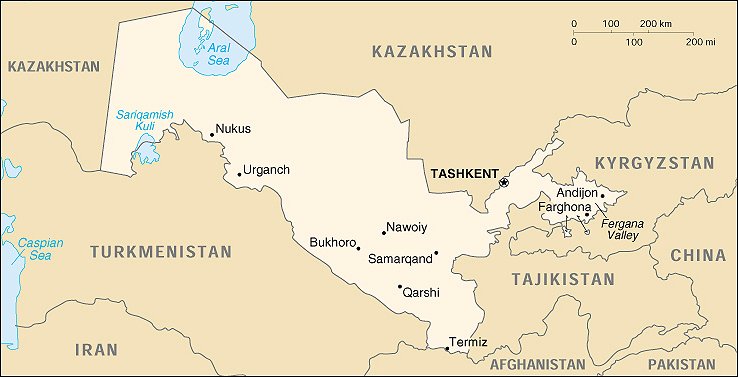
|
Country Information |
Since
the collapse of the Soviet Union, Uzbekistan has emerged
as the regional power in Central Asia, partly because of
its relatively large population, extensive natural resources,
cohesive military and the dominant authoritarian regime
of President Islam Karimov. However, the country is beset
with serious environmental problems that adversely effect
the life and health of its citizens. It has widespread poverty
and unemployment.
Use
of water from the Aral Sea for irrigation has led to 60-percent
salination of cropland. Poisonous dust and salt clouds,
compounded by the recent three-year drought, continue to
affect the health of local residents. The Aral Sea remains
one of the world's worst socio-environmental disasters.
Additional problems include water pollution from industrial
wastes and the heavy use of fertilizers and pesticides and
soil contamination from agricultural chemicals.
Political
opposition is suppressed and although the Uzbek parliament
in 1998 approved constitutional measures to promote press
freedom, the media remains controlled. Human rights groups
have accused Uzbekistan's secular regime of using its fight
against fundamentalism as a pretext for cracking down on
its political opponents.
Located
along the ancient silk trading routes, Uzbekistan was conquered
by Genghis Khan in the thirteenth and Timur (Tamerlane)
in the fourteenth century. By the late 1800s, the territory
had been incorporated into the Russian empire. The Uzbekistan
Soviet Socialist Republic was established in 1924, and its
eastern region was made a separate Tajik Soviet republic
five years later. Independence came in 1991. The armed Islamic
Movement of Uzbekistan (IMU), which has threatened to create
an Islamic state in the region, has operated out of Afghanistan
and Tajikistan, reportedly with support from Afghanistan's
former Taliban regime. The IMU sometimes attracts sympathy
from dispossessed and impoverished people, particularly
in the south and the eastern Ferghana Valley. The IMU reportedly
controls lucrative narcotics routes throughout Central Asia.
Uzbekistan
hosts thousands of refugees from Tajikistan, Afghanistan
and other countries. The Tajik refugees are largely ethnic
Uzbeks. The legacy of large-scale Soviet era farming schemes
has had dire implications for the four million people who
live downstream.
Uzbekistan
is the world's fourth-largest producer of cotton and the
world's second-largest exporter, accounting for about 45
percent of the country's exports. Minerals and mining are
another foundation of Uzbekistan's economy. The country
is the world's seventh largest producer of gold and holds
the fourth largest reserves.
According
to the Manila-based Asia Development Bank, the Gross Domestic
Product growth in 2001 at 4.5 percent was marginally higher
than in 2000. The government envisages GDP growth at 5.1
percent in 2002 but this may not be realized given the global
economic environment, continuing softness in international
commodity prices, and the short term impact of the government's
economic policy changes.
|
|
| Country
Data |
| Capital |
Tashkent |
|
|
| Population |
25,5 million |
|
|
| Life Expectancy |
63.9 |
|
|
| GDP |
$62 billion (purchasing power parity) |
|
|
| GDP per capita |
$2,500 (purchasing power parity) |
|
|
| Political structure |
Presidential (dominant party) |
|
|
| Independence |
1 September 1991 (from Soviet Union) |
|
|
| Ethnic Groups |
Uzbek (80 percent), Russian (6 percent), Tajik (5 percent),
Kazakh (3 percent), other (6 percent) |
|
|
| Religions |
Sunni Muslim (88 percent), Eastern Orthodox (9 percent), other
(3 percent). |
|
|
| Geography |
Flat-to-rolling sandy desert with dunes; broad, flat intensely irrigated river valleys along Amu Darya, Syr Darya; shrinking Aral Sea; semi-arid grasslands in east |
|
|
| Border countries |
Turkmenistan, Kazakhstan, Afghanistan, Tajikistan, the Kyrgyz Republic
|
|
|
| Natural resources |
Natural gas, petroleum, coal, gold, uranium, silver, copper, lead
and zinc, tungsten, molybdenum |
|
|
| Agriculture products |
Cotton, vegetables, fruits, grain, livestock |
|
|
| Other products |
Not applicable |
|
|
| Literacy rate |
99 percent (men)
99 percent (women) |
|
|
| Under five mortality rate |
71.72 (per 1,000 live births) |
|
|
| HIV/AIDS prevalence |
0.01 percent (adults) |
|
|
| External debt |
$5.1 billion (2001) |
|
|
| Economic aid |
$276.6 million (1995) |
|
|
| Internally displaced |
Not applicable |
|
|
| Refugees |
Uzbekistan hosted some 38,400 refugees at the end of 2000. About
30,000 were from Tajikistan, 8,000 from Afghanistan and
400 from other countries. |
|
|
Note: Uzbekistan ranked 107 on the UN Development Program's
Human Development Index for 2003.
Additional details
|
|
|
| Links
|
Links to other sources
Interactive Central Asia Resource Project
US
Committee for Refugees
US State Department Background Notes
|
|
Top
of the Page 
|
| ? |
|
View enlarged map
|