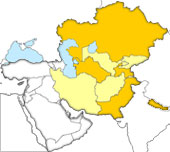
|
Country Information |
Elections
in recent years have ushered in a more liberal era in Iran
under President Mohammed Khatami. But the president holds
little real power under the constraints of a political system
that remains highly restrictive despite some political and
economic reforms. Conservatives have used the courts and
mosques to limit liberalization. Following the fall of the
Taliban in neighboring Afghanistan, Iran and Pakistan began
attempts at resolving their differences. They had long vied
for influence in Afghanistan and viewed one another with
suspicion. Iran fiercely opposed the Taliban.
Historically
known as Persia, Iran was once one of the greatest empires
of the ancient world. Its territory has been invaded frequently
over the centuries. Iran's hereditary monarch, Shah Mohammad
Reza Pahlavi, fled the country in 1979 after decades of
corrupt and authoritarian rule, and mounting religious and
political unrest. Exiled Ayatollah Ruhollah Khomeini returned
to lead an Islamic revolution and formed the world's first
Islamic republic. An eight-year war with Iraq followed.
Iran
hosts more refugees - nearly two million - than any other
country in the world. Most are from Afghanistan and are
dispersed throughout the country employed as manual laborers.
Less than five percent of refugees in Iran live in camps.
Iran feared a huge influx of Afghan refugees when the US-led
strikes against the Taliban began and said it would help
provide humanitarian aid to Afghans across the border. The
exodus to Iran did not materialize. About 24,000 Iranians
have sought refuge in neighboring Iraq. Tens of thousands
of others have left the country for a combination of political
and economic reasons, inflicting a significant brain drain
on Iranian society. Northern Iran in August 2001 was devastated
by its worst floods in 200 years.
Economic disarray plagues Iran, which relies heavily oil
and suffers and gains from its fluctuating prices. Iran
has sought more cordial relations with the West and neighboring
Arab countries in recent years, in part to attract much-needed
foreign investment.
|
|
| Country
Data |
| Capital |
Teheran |
|
|
| Population |
66.5 million
|
|
|
| Life Expectancy |
70.25 |
|
|
| GDP |
$456 billion (2002) (purchasing power parity)
|
|
|
| GDP per capita |
$7,000 (2001) (purchasing power parity) |
|
|
| Political structure |
Presidential-parliamentary
(clergy-dominated) |
|
|
| Independence |
1 April 1979 (Islamic Republic of Iran proclaimed) |
|
|
| Ethnic Groups |
Persian (51 percent), Azeri (24 percent), Gilaki and Mazandarani (8 percent), Kurd (7 percent), Arab (3 percent), other (7 percent) |
|
|
| Religions |
Shi'a Muslim (89 percent), Sunni Muslim (10 percent), Zoroastrian, Jewish, Christian, and Baha'i (1 percent) |
|
|
| Geography |
Desert and mountains, semi-arid, subtropical along the Caspian
coast |
|
|
| Border countries |
Iraq, Turkey, Azerbaijan, Turkmenistan, Afghanistan, Pakistan |
|
|
| Natural resources |
petroleum, natural gas, coal, chromium, copper, iron ore, lead, manganese, zinc, sulfur |
|
|
| Agriculture products |
Wheat, rice, other grains, sugarbeets, fruits, nuts, cotton,
dairy products, wool, caviar |
|
|
| Other products |
Petroleum, petrochemicals, textiles, cement and building materials, food processing (particularly sugar refining and vegetable oil production), metal fabricating (steel and copper) |
|
|
| Literacy rate |
78.4
percent (male)
65.8 percent (female) |
|
|
| Under five mortality rate |
28.07 (per 1,000 live births) |
|
|
| HIV/AIDS prevalence |
0.01 percent |
|
|
| External debt |
$8.2 billion (2002) |
|
|
| Economic aid |
$116.5 million (1995) |
|
|
| Internally displaced |
Not applicable |
|
|
| Refugees |
Iran hosts about 1.5 million refugees from Afghanistan, 387,000
from Iraq and 26,000 from other countries. About 24,000 Iranian refugees are living in Iraq. |
|
|
Note: Iran ranked 101 on the UN Development Program's Human Development Index for 2003.
Additional details
|
|
|
| Links
|
Links to other sources
US Committee for Refugees
US State Department Background Notes
Iran Daily
|
|
Top
of the Page 
|
| ? |
|
View enlarged map
|