|
Country Information |
The
Kyrgyz Republic was once considered Central Asia's greatest
hope for democracy, but seriously flawed elections in 2000,
intimidation of opposition leaders and increasing pressure
on the local press have tarnished its image. The Islamic
Movement of Uzbekistan (IMU) appears to have suffered significant
logistical setbacks as a consequence of the war in Afghanistan
and the subsequent loss of a safe rear-base for their operations,
but are rumoured to be regrouping in the Fergana Valley.
There is concern that harsh poverty and repressive government
policies on Muslims in the region may inspire growing sympathy
for insurgencies and lead to widespread civil unrest. Kyrgyz
officials say the IMU's primary aim is to expand lucrative
drug trafficking throughout the region.
Faced
with acute poverty, poor economic performance and attendant
high unemployment rates, prostitution and the trafficking
of girls are rife. There has also been a rise in heroin
addiction and HIV infection, particularly in the south,
which is a transit route for drugs heading from Afghanistan
to Western Europe. The Kyrgyz Republic hosts some 11,000
refugees, including 9,800 mainly ethnic Kyrgyz from neighboring
Tajikistan. Displacement has occurred in the south, following
IMU incursions. The unilateral decision by Uzbekistan to
place land mines along the unmarked and meandering Tajik
and Kyrgyz borders has led to civilian casualties.
The
area now known as the Kyrgyz Republic was populated by nomadic
herders and ruled by tribal leaders for centuries before
being conquered by Russia in the mid-1800s. It was incorporated
into the Soviet Union in 1924 and independence followed
in 1991.
There has been tension between Uzbek and Kyrgyz speakers,
with official preference for the latter and a growing North/South
divide. But a recent decision to include Russian as an official
language - the only Central Asian republic to do so - has
somewhat reassured the skilled Russian minority that remains.
The collapse of the Soviet Union and exodus of skilled workers
plunged the region into economic disarray, severely affecting
the Kyrgyz Republic's agriculture-based economy.
|
|
| Country
Data |
| Capital |
Bishkek |
|
|
| Population |
4.8 million |
|
|
| Life Expectancy |
63.56 |
|
|
| GDP |
$13.5 billion (purchasing power parity)
|
|
|
| GDP per capita |
$2,800 (purchasing power parity) |
|
|
| Political structure |
Presidential |
|
|
| Independence |
31 August 1991, (from Soviet Union) |
|
|
| Ethnic Groups |
Kyrgyz (52 percent), Russian (18 percent), Uzbek (13 percent),
Ukrainian (3 percent), other (14 percent) |
|
|
| Religions |
Sunni Muslim (75 percent), Russian Orthodox (20 percent), other
(5 percent) |
|
|
| Geography |
Mostly mountainous with some desert regions |
|
|
| Border countries |
Kazakhstan, China, Tajikistan, Uzbekistan |
|
|
| Natural resources |
Abundant hydropower, significant deposits of gold and rare earth
metals, coal, minimal oil and natural gas, other deposits
of mercury, bismuth, lead and zinc. |
|
|
| Agriculture products |
Tobacco, cotton, potatoes, grapes, fruits and berries, sheep, goats,
cattle, wool. |
|
|
| Other products |
Small machinery, textiles, food processing, cement, shoes, sawn
logs, refrigerators, furniture, electric motors, gold, rare earth metals. |
|
|
| Literacy rate |
99 percent (male)
96 percent (female) |
|
|
| Under five mortality rate |
75.92 (per 1,000 live births) |
|
|
| HIV/AIDS prevalence |
0.01 percent (adults) |
|
|
| External debt |
$1.6 billion (2001) |
|
|
| Economic aid |
No current data available |
|
|
| Internally displaced |
Occasional displacement in the south because of rebel incursions. |
|
|
| Refugees |
The Kyrgyz Republic hosted about 11,000 refugees at the end
of 2000, including 9,800 from Tajikistan (mainly ethnic
Kyrgyz), 800 from Afghanistan and 400 from the Russian
Federation. |
|
|
Note: The Kyrgyz Republic ranked 110 on the UN Development Program's
Human Development Index for 2003.
Additional details
|
|
|
| Links
|
Links to other sources
Interactive Central Asia Resource Project
US Committee for Refugees
US State Department Background Notes
|
|
Top
of the Page 
|
| ? |
|
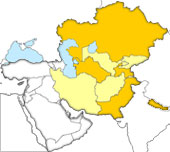
View enlarged map
|