|
Country Information |
After more than two decades of civil war
and conflict, combined with the worst drought in 30 years,
there is widespread suffering and massive displacement of
the population inside and outside Afghanistan. The United
Nations estimates that seven million people are vulnerable
to famine. Afghanistan's infrastructure has been nearly destroyed,
its human resource base severely depleted and its social capital
eroded. Following the toppling of the Taliban regime by U.S.
and opposition Northern Alliance forces, UN-brokered talks
in December 2001 provided a framework for future Afghan governance,
including an interim authority, elections and a multinational
peacekeeping force for the capital, Kabul.
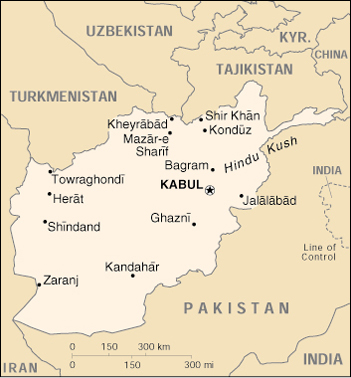
 Afghanistan,
a mountainous and landlocked country, has long been fought
over because of its strategic location between the Middle
East, Central Asia and the Indian subcontinent. The former
Soviet Union invaded Afghanistan in 1979 and occupied the
country for a decade before withdrawing under pressure by
mujahidin forces who were supported by the United States,
Saudi Arabia, Pakistan and others. Fighting continued, however,
among Afghan factions, most recently between the Taliban,
a group which imposed a strict form of Islam over much of
the country in 1996, and opposition Northern Alliance forces. Afghanistan,
a mountainous and landlocked country, has long been fought
over because of its strategic location between the Middle
East, Central Asia and the Indian subcontinent. The former
Soviet Union invaded Afghanistan in 1979 and occupied the
country for a decade before withdrawing under pressure by
mujahidin forces who were supported by the United States,
Saudi Arabia, Pakistan and others. Fighting continued, however,
among Afghan factions, most recently between the Taliban,
a group which imposed a strict form of Islam over much of
the country in 1996, and opposition Northern Alliance forces.
During the Soviet occupation, one-third
of the population fled Afghanistan. Pakistan and Iran provided
refuge for a combined peak of more than six million refugees.
Afghanistan is the world's leading source of refugees. An
estimated four million people are refugees in neighbouring
Pakistan and Iran. Many refugees began returning to the country
in November 2001 after the fall of the Taliban. Afghanistan
is the most heavily mined country in the world.
UNHCR, together with the Iranian and Pakistani
governments, began its largest ever voluntary repatriation
operation in 2002 with plans to help some 1.2 million Afghan
refugees and displaced persons home this year alone.
Since 1988, the UN Office for the Coordination
of Humanitarian Assistance to Afghanistan has channeled more
than $1 billion in multilateral assistance to Afghan refugees
and vulnerable persons inside Afghanistan. The country is
highly dependent on farming and raising livestock. But as
the largest producer of opium poppies, drug trafficking provides
a major source.
|
|
| Country
Data |
| Capital |
Kabul |
|
|
| Population |
27,7 million [estimated, with 4 million
in neighboring Pakistan, Iran] |
|
|
| Life Expectancy |
46.6 |
|
|
| GDP |
$21 billion (purchasing power parity) |
|
|
| GDP per capita |
$800 (purchasing power parity) |
|
|
| Political structure |
Interim government
|
|
|
| Ethnic Groups |
Pashtun, Tajik, Hazara, Uzbek, Aimak, Turkmen, Baloch and others |
|
|
| Religions |
Sunni Muslim
(84 percent), Shi'a Muslim (15 percent), other (1 percent) |
|
|
| Geography |
Landlocked, arid to semiarid,
mostly rugged mountains with fertile valleys |
|
|
| Border countries |
China, Iran, Pakistan, Tajikistan,
Turkmenistan, Uzbekistan |
|
|
| Natural resources |
Natural gas, petroleum, coal, copper, chromite, talc, barites, sulfur, lead, zinc, iron ore, salt, precious and semiprecious stones |
|
|
| Agriculture products |
Opium, fruits and nuts, wool,
cotton, rice, cotton, sugar cane |
|
|
| Other products |
Hand woven carpets, handicrafts
|
|
|
| Literacy rate |
51 percent (male)
21 percent
(female) |
|
|
| Under five mortality rate |
144.76 (per 1,000 live births) - One
of the highest in the world |
|
|
| HIV/AIDS prevalence |
Less than 0.01 percent (1999) |
|
|
| External debt |
$5.5 billion (1996) |
|
|
| Economic aid |
No current data available |
|
|
| Internally displaced |
900,000 (as of October 2001) by
conflict or drought |
|
|
| Refugees |
There were some 5 million Afghans
living abroad as of May 2001 |
|
|
Afghanistan was not ranked on the UN Development
Program's Human Development Index for 2003.
Additional details |
|
|
| Links
|
Links to other sources
Interactive
Central Asia Resource Project
US
Committee for Refugees
US
State Department Background Notes
|
|
Top
of the Page 
|
| ? |
|
View enlarged map
|