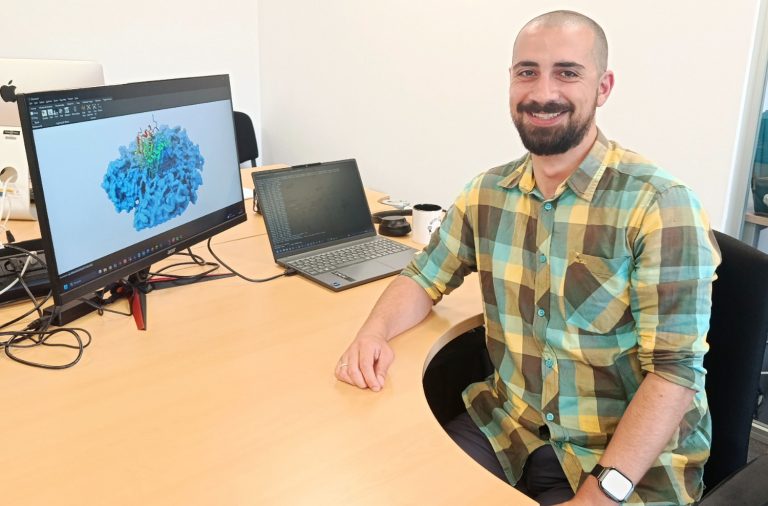
The Porto-based researcher Alexandre Pinto is studying the use of artificial intelligence in computational design tools for enzymes, with the aim of creating organisms capable of degrading several types of plastics.
Specifically, he has been working on a particular enzyme related to PET, the poly(ethylene terephthalate), from which, according to global figures, nearly 500 billion bottles of this plastic are produced each year, the researcher told Lusa, who is also an invited associate professor at the Faculty of Sciences of the University of Porto (FCUP).
The work, at this stage, is to “simulate the enzyme” to study how it works with plastics, to “study how, eventually, it will catalyze the chemical reaction,” using these simulations as a basis for artificial intelligence, whose use reduces the costs and resources used to perform the same work.
This study led him to a grant from the Federation of European Biochemical Societies and the University of Girona, where he will work until Friday, on the way to other grants he seeks to apply for, to pursue work that, he admits, is still in an early stage of the chain that can lead to practical market application.
This current grant is “a good opportunity” to kick off a project “even more in-depth and broader,” with other classes of plastics under study.
These experimental studies come from the work he did in his PhD in Chemistry, which he completed in 2025, and he will continue without a “final objective, because it is something that has to be continually optimized.”
The fascination with enzymes, entities “so complex” that captivated him, coupled with environmental concerns, leads him to study applications that can have an impact on daily life, especially in a context where, he notes, Portugal is still behind the necessary recycling figures.
“I am looking at data from Plastics Europe, for 2024, and from all plastics produced, i.e., all that enter the market, 9.5% are recycled by mechanical methods, and only 0.1% are recycled by chemical methods,” he recalls.