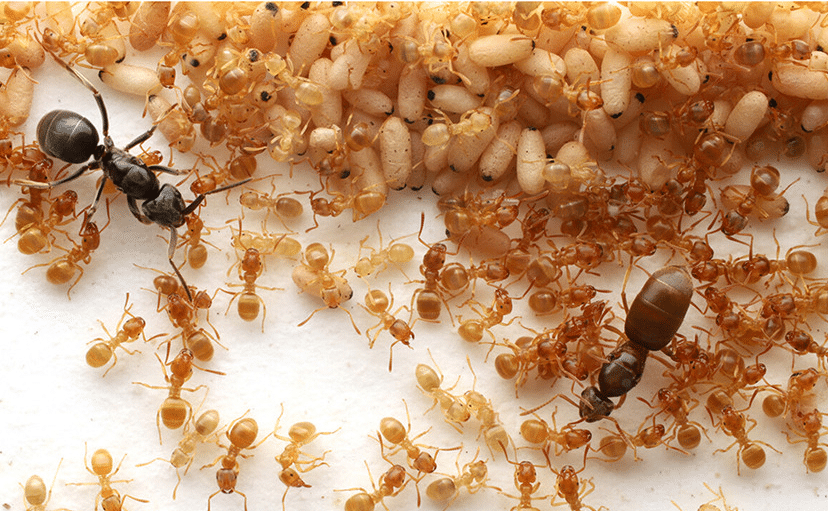
In the world of parasitic ants, females that infiltrate other colonies to dethrone their respective queens and seize the throne, the assaults typically involve a fierce fight and even death between the resident queen and the conqueror.
However, a study published in the journal Current Biology reveals a more sublime tactic that reduces the risks faced by the invader. A trio of Japanese scientists discovered that the female parasitic ants of the species Lasius orientalis and Lasius umbratus are capable of driving the workers of Lasius flavus and Lasius japonicus to kill their own queens and mothers. Notably, in ant colonies, only the queens reproduce, so all the workers are, in fact, sisters to one another and daughters of the queen.
According to the researchers, since the early 20th century it has been known that ants of the genus Lasius were capable of matricide, but it was not known what motivated this unusual behavior in the animal kingdom. That mystery is now solved.
The scientists reveal that the female invading ants, both L. orientalis and L. umbratus, use a chemical substance to make the workers of the colony they intend to conquer enter a matricidal frenzy. After the resident queen is killed, the invader is promptly welcomed by the workers and begins to produce her own eggs, which will be cared for by the now-orphaned ants.
The authors suggest that the substance in question, which provokes a kind of “chemical hypnosis,” is formic acid, a defense used by many ant species to deter predators or to alert their colony partners to danger. However, in this invasion context, what is thought to be formic acid appears to be used to deceive the workers of the invaded colony.
Belonging to the same genus, both invading and invaded recognize formic acid as a danger signal, but when the queen to be toppled is sprayed with a large amount of that substance by the conqueror, the workers, it is thought, come to view the progenitor as a threat to the colony, triggering an aggressive defensive response.
But how do the invading ants manage to enter the colony without being detected and thwarted? The queen-to-be candidates spend some time with the workers of the colony they want to take for themselves, stealing the scent of that group and, thus, leading them to think they are just another member of the family.
In the laboratory, the scientists observed that the females L. orientalis spray the queen L. flavus more than 16 times over about 20 hours. The queen is attacked by her workers until she dies four days later. In the case of L. umbratus, the invading females spray the queens of L. japonicus only twice before the workers kill their mother in less than a day.