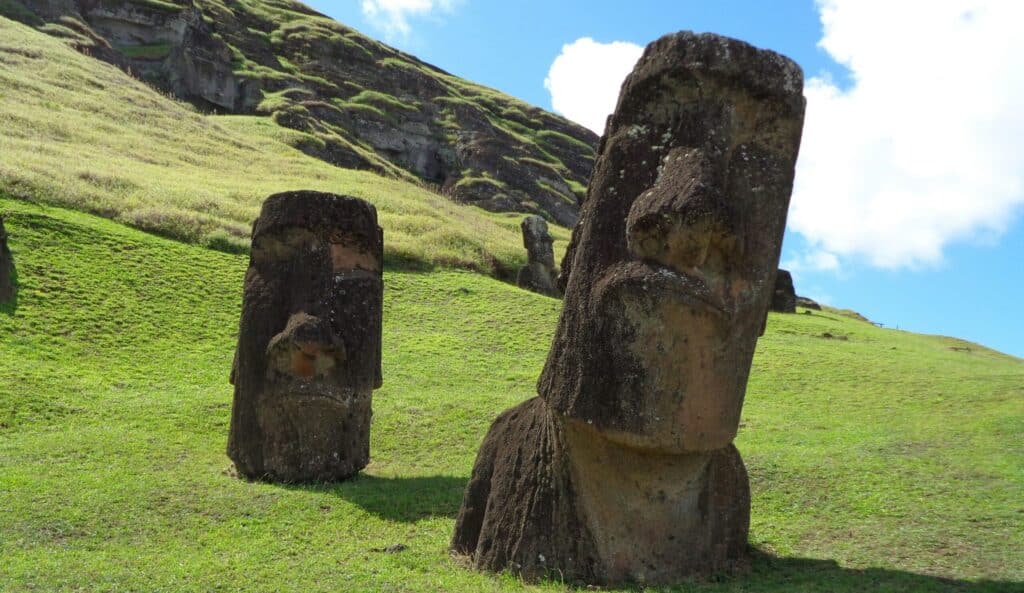
The construction of the famous moai of Easter Island (also known as Rapa Nui) did not result from centralized management, but from the work of numerous autonomous groups. The conclusion is presented in a study published in the journal PLOS One, conducted by Carl Philipp Lipo, from Binghamton University (New York), and by an international team of researchers.
Rapa Nui is known for the hundreds of monumental statues carved by Polynesian communities from the 13th century. Archaeological research has consistently pointed to a society composed of small family clans, politically independent. It remained to confirm whether the production of the moai followed the same decentralized logic.
To answer this question, the researchers collected more than 11,000 images of the island’s main quarry, Rano Raraku, and developed a detailed three-dimensional model of the site, where hundreds of moai remain in different stages of execution. The analysis of this model revealed 30 distinct workshop centers, with varied techniques, indicating zones of independent work. Traces of transporting the statues in multiple directions were also identified, reinforcing the absence of centralized coordination.
These findings contradict the idea that the production of monuments of this scale requires a hierarchical structure. The similarities among the moai seem to arise primarily from the cultural sharing of knowledge, rather than from joint teams of labor. The quarry model created within the scope of this study also opens new possibilities for future investigations and for the heritage management of this UNESCO World Heritage Site, potentially serving as a basis for analyses at other locations on the island.
“Much of the so-called ‘mystery’ of Rapa Nui stems from the lack of detailed and accessible data that allow evaluating hypotheses and constructing explanations,” the authors state. “The high-resolution 3D model we present for the Rano Raraku quarry — responsible for nearly a thousand statues — provides new insights into the processes of organization and manufacture of these megalithic figures.”