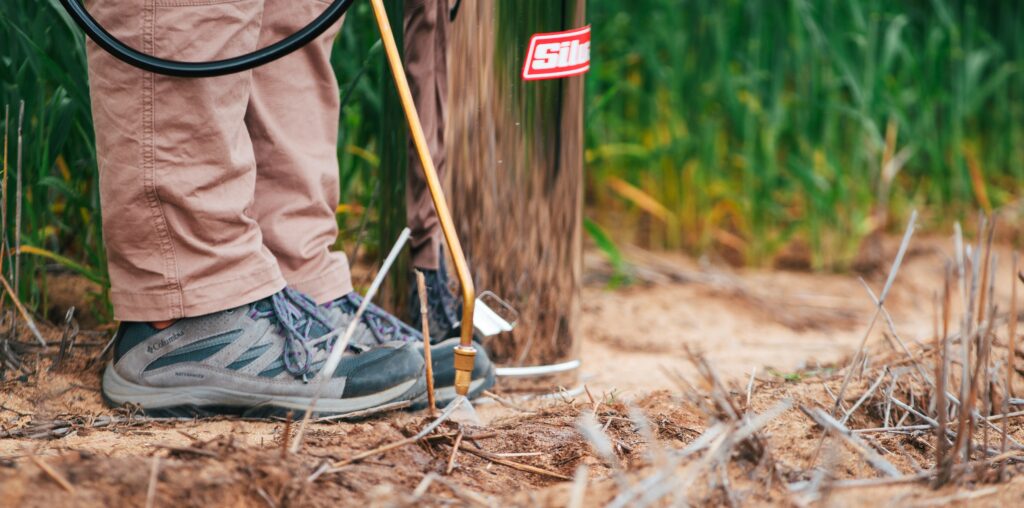
A team of researchers from Murdoch University has developed an innovative technology that could help farmers mitigate the effects of drought and diminishing rainfall. It is called SMART SPRAYS, a spray produced from a biodegradable polymer capable of capturing and redirecting rainwater to crop seeds.
The technology has already been tested on farms in Western Australia, and the researchers hope to turn it into a commercially viable product in the coming years.
Agriculture is one of the economic pillars of Western Australia, generating billions of dollars annually. However, the increasing frequency and intensity of droughts, linked to climate change, has been compromising agricultural productivity, food security and the economic sustainability of farms.
According to specialists from the university’s Center for Bioplastics Innovation, the Wheatbelt region known as the Wheatbelt has recorded a reduction of about 20% in winter rainfall over the last 25 years, raising concerns about the future capacity to produce essential foods.
Professor Daniel Murphy, the project lead, stressed the importance of improving water retention in agricultural soils. “If we can increase the availability of water near the plant roots, we can help farmers boost crop yields,” he said.
Researcher Cheryl Rimmer explained that SMART SPRAYS use a polymer derived from natural bacteria. This material exhibits hydrophobic properties, that is, it repels water, allowing rainfall to be directed to the furrows where the seeds are located, while reducing evaporation losses.
Western Australia accounts for about 45% of the country’s wheat production. According to the researchers, if forecasts of shorter and less intense rainfall are confirmed, production of this crop could be seriously compromised.
Meanwhile, doctoral student Samantha Viljoen highlighted the environmental credentials of the technology. “We are harnessing a natural product and nature’s own capacity. We are not introducing synthetic plastics into the soil nor leaving microplastic residues or chemical additives typically associated with agricultural plastic mulches,” she explains.
Farmers who participated in the trials consider that the innovation could be particularly useful in a context of reduced winter rainfall. Andrew Crook noted that producers need to make the most of every millimeter of rainfall available and adapt their farming practices to changing climate patterns.
After the demonstration phase is completed, the university team, with the support of the Grains Research and Development Corporation, will move forward with developing a commercial version of the technology intended for large-scale cereal producers.
Those responsible for the project believe that SMART SPRAYS could represent an important tool to increase water-use efficiency, reduce evaporation losses, and strengthen the resilience of agriculture in the face of the challenges posed by climate change.