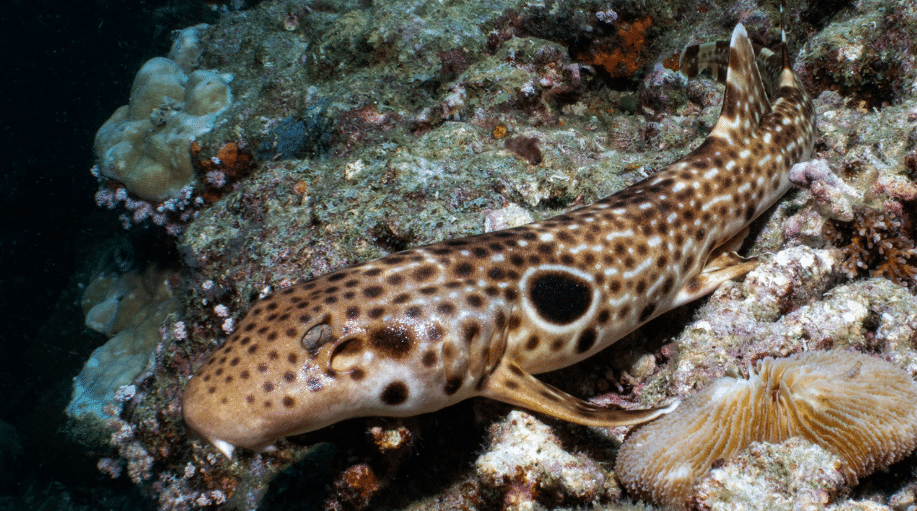
It may seem something straight out of a science-fiction movie, but it’s true: there are sharks that can move along the sea floor, using their fins as if they were legs.
These peculiar animals belong to the genus Hemiscyllium, also known as walking sharks, a group that until recently consisted of nine scientifically described species. Now, a tenth has been added, which is also the first of the genus to be discovered since 2013.
The new species was found in the marine waters off the southeast coast of Papua New Guinea, during a night dive, a period when it is most active. It was given the scientific name Hemiscyllium dudgeonae, in honor of Christine Dudgeon, a researcher at the University of Sunshine Coast (Australia), a shark genetics specialist and the principal co-author of the article documenting the discovery.
The first specimen of what scientists believed to be a new species was documented in March 2025. Days later, after an intensive exploration of the reefs at the site where they encountered the first individual, the team detected another 11.
These sharks feed on invertebrates on the seabed, using the four fins as if they were legs to move about on the reefs, and pose no danger to humans.
Coloration was one of the main characteristics that led scientists to strongly suspect they were dealing with a new species.
“I immediately noticed that the coloration pattern was different from that of any other species I had previously worked with,” recalls Jessica Anne Blakeway, the first author of the study.
“The first thing that drew our attention were the white markings along its brown body. These markings were quite different from the leopard-like spots we expected to see,” she adds.
Being a gentle and compliant animal, the first specimen found was brought to the boat in the divers’ hands, for closer examination. Through genetic analysis of samples collected aboard the scientific vessel, the new species was confirmed.
The shark is known among local communities by the name kadedekedewa, which can be translated as “dog shark” or “lazy shark,” due to its slow locomotion and support by four “legs.”
Because it has a seemingly very restricted distribution area, researchers are concerned about the possibility that the species, although only now scientifically described, may be threatened with extinction. To confirm its conservation status, they hope to collect more data on the species in October this year, the date of the next scientific expedition, to confirm the conservation status, which they believe to be “vulnerable” or “endangered.”
Five of the ten Hemiscyllium species known so far are already classified as at risk of extinction, particularly due to their very restricted distribution areas.