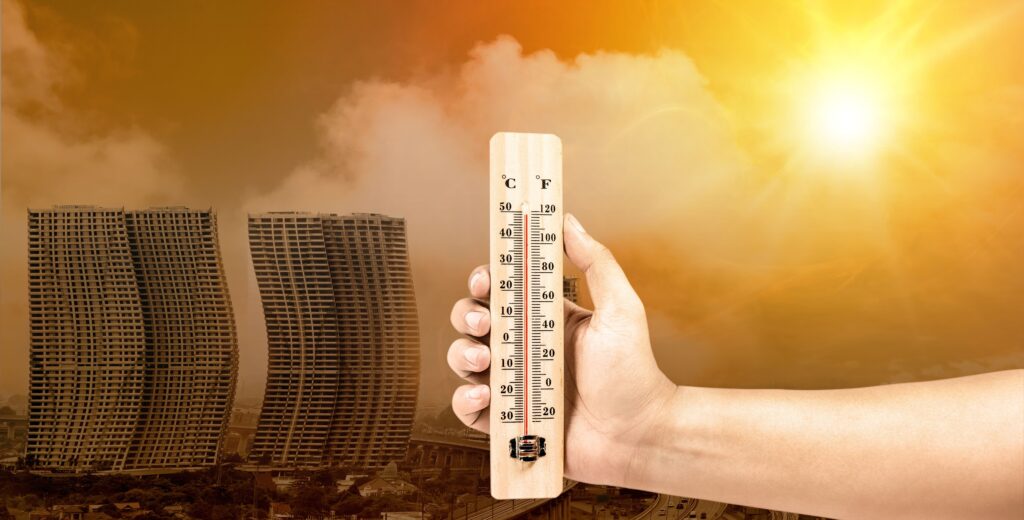
Forty-five percent of European cities have hit or are about to surpass the historical highs of thermal stress during the current heatwave across the continent, according to a study published today by World Weather Attribution.
The analysis conducted in 854 cities across 30 European countries concluded that 385 locations have surpassed or could surpass in the coming days the highest records of global and wet-bulb temperature readings.
This indicator, known by its English acronym WBGT, is a real estimate of the combined effect of temperature, humidity, wind speed, and visible and infrared radiation on the human body.
The researchers warn that the combination of extreme temperatures and high humidity significantly increases health risks, especially among the elderly, outdoor workers, children and vulnerable people.
According to the analysis, the current heatwave would have been “practically impossible” just 50 years ago, since both the daytime and nighttime temperatures recorded during a heatwave on the same dates in 1975 would be 3.5 degrees Celsius (°C) lower.
The investigation also notes that high nighttime temperatures — one of the factors that most affect health by hindering the body’s recovery — are now 100 times more likely than they were 23 years ago, when Europe experienced a historic heatwave, while daytime highs are up to 10 times more frequent.
Scientists attribute the intensity of these phenomena to the impact of global warming, driven by “ongoing emissions of fossil fuels” into the atmosphere.
“The science explaining how climate change is intensifying heatwaves is unequivocal and the pace of change is alarming. Every few years we have witnessed heat records in Europe, but this year that happened in consecutive months,” says Theodore Keeping, a researcher specializing in meteorological phenomena and wildfires at Imperial College London.
The UN Climate Change Executive Secretary, Simon Stiell, says that the extreme heat affecting Europe is a symptom that climate change “is advancing out of control,” driven by the “global addiction to burning coal, oil and gas,” although he emphasizes that “the solutions are equally clear.”
According to Stiell, there is a need “for a faster transition to clean energy, which is now much cheaper than fossil fuels, as well as the protection of forests and the promotion of climate resilience.”
Equally alarming are the statements by Imperial College London climate science professor Friederike Otto, who laments that scientists are starting to sound “like a broken record.”
“Yes, this is climate change, yes, we are to blame, no, it is not El Niño; yes, we have solutions, no, we are not applying them quickly enough,” she says.