Better weather forecasts, in themselves, may not be sufficient to protect the poorest farmers from the effects of climate change. This is the conclusion of an international study led by the University of Sydney and Imperial College London, which analyzed the impacts of climate variability on pastoralist communities in seven Southern African countries.
Published in the journal Nature Sustainability, the study shows that climate information is more effective when accompanied by risk-reduction measures, such as providing supplementary feed for cattle, drought insurance, targeted financial support, or improved access to markets. These measures enable producers facing the risk of losing their animals to make decisions before drought takes hold.
According to the researchers, the next El Niño event could worsen inequalities in the pastoral regions of Southern Africa. “If forecasts materialize and we see the development of an El Niño near record levels, we expect that this will widen inequalities in the pastoral regions of Southern Africa,” says Matt Clark, a researcher at the University of Sydney and the study’s lead author.
“The problem isn’t that the poorer farmers don’t have climate information. The problem is that, often, they can’t afford to act on it. Wealthier producers can reduce the size of their herds before a drought and rebuild them when conditions improve. Many small herders simply don’t have that financial cushion.”
The difference between having information and being able to act
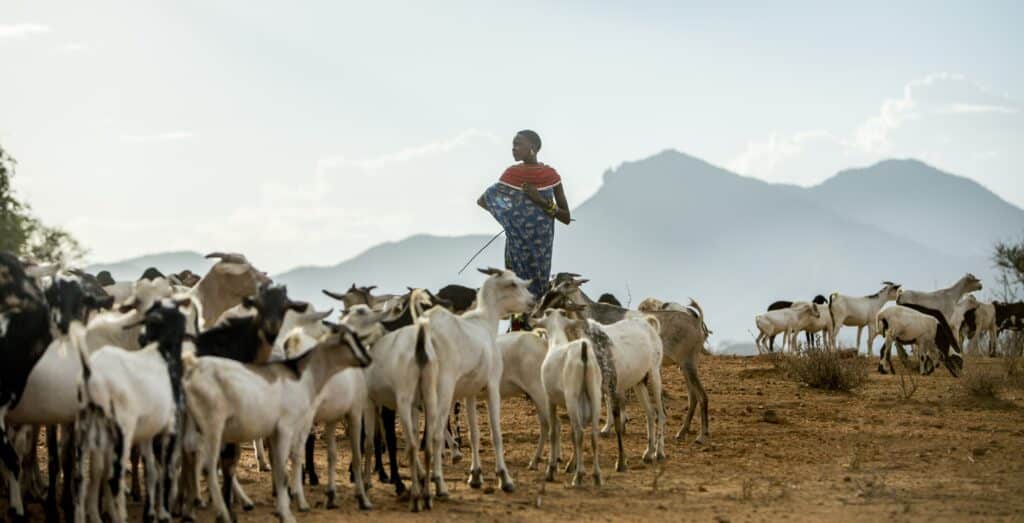
Millions of herders depend on cattle, sheep, and goats across the vast grazing regions that cross countries such as Botswana, Eswatini, Lesotho, Mozambique, Namibia, South Africa, and Zimbabwe. For these families, livestock means much more than a source of income: it is a form of savings, a guarantee of food security, and part of cultural identity, often passed down between generations.
As climate change increases the variability between favorable seasons and periods of severe drought, decisions become more difficult. Owners of larger herds can, in many cases, sell animals before the drought, preserve part of their savings, and rebuild their herds when conditions improve. Poorer shepherds have fewer options and may be forced to keep animals on increasingly degraded lands, risking losses that can prolong or worsen poverty.
“It’s not that the people we work with aren’t thinking about adapting to climate change,” explains Gina Arena, the scientific lead of the Herding for Health initiative at Conservation International. “It’s that, with greater climate uncertainty, risk also increases. We need to help people identify the best decisions and reduce the risk associated with implementing them. Research like this helps us do that.”
The researchers combined detailed models with fieldwork conducted by non-governmental organizations and concluded that climate forecasts can become significantly more useful when there are mechanisms that enable families to respond proactively to drought.
“The encouraging conclusion is that this doesn’t involve inventing a new technology. It is about applying existing knowledge in new ways,” says Matt Clark. “Weather forecasts are becoming increasingly accurate. The opportunity now is to ensure that these forecasts are accompanied by practical support, so that the people who need them most can really benefit.”
Modeling thousands of decisions
To test different adaptation strategies, the team developed a model that represents pastoralist communities in seven Southern African countries. The model combined precipitation projections from European climate models with data on livestock, vegetation, and community wealth.
In the first simulation, corresponding to a scenario of continuing current trends, the increasing variability of precipitation led to a reduction in family wealth, higher losses of cattle, pasture degradation, and worsening inequalities.
A second simulation evaluated different adaptation strategies. Access to climate forecasts, by itself, produced limited benefits, since many families did not have the financial capacity to respond to the information. Conversely, risk-reduction measures applied in isolation could create other environmental impacts.
A third simulation examined the possibility of adaptation strategies spreading between neighboring communities. Based on conservation programs such as Herding for Health, by Conservation International, the results showed that when practical support is combined with climate information, communities can learn from each other and the adoption of the measures can reinforce itself progressively.
“It’s easy to think that mathematical modeling is something abstract, but in this case it’s doing something very practical,” explains Cosima Fröhner, former Mary Lister McCammon Fellow at Imperial College London. “We simulate the decisions of thousands of individual farmers under different climatic conditions and adaptation interventions. As the model reaches a stable state, broader patterns and the trade-offs among the different interventions emerge from these individual decisions.”
For Matt Clark, the approach could be applied beyond Southern Africa, including regions of Australia that face greater rainfall variability.
“The methodology we developed for the shepherds of Southern Africa could equally be applied in Australia and other regions facing increasingly variable rainfall. As climatic extremes become more frequent, adaptation must involve both helping people to act and improving the forecasts themselves.”