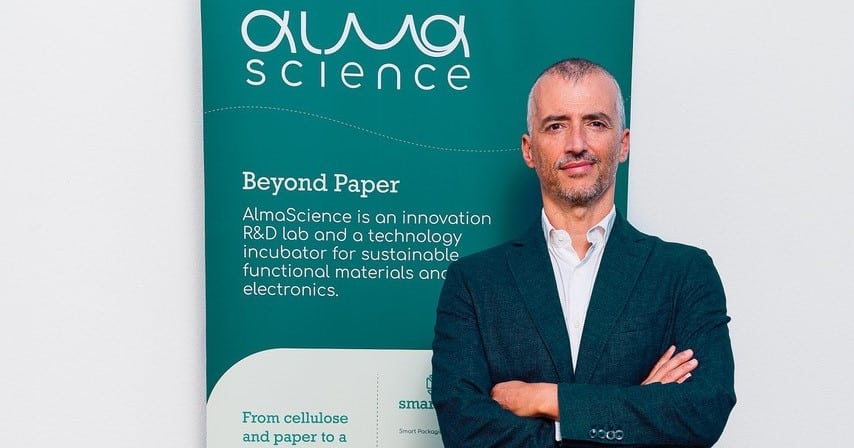
Many Portuguese companies remain tied to traditional plastic and metal solutions, but AlmaScience proves that it is possible to invest in sustainable technology without compromising performance or profit. In an interview with Green Savers, Carlos Silva, President and CEO of AlmaScience, explains how the laboratory turns research into functional prototypes with real industry impact. The objective is to drive green electronics and circular materials in the national market.
Created in 2020, AlmaScience emerged to fill a gap in national innovation: bringing scientific research closer to the real needs of companies. With a multidisciplinary team that brings together chemists, engineers, design and business specialists, the laboratory develops practical solutions such as biodegradable paper sensors, hydrogel labels, and smart retail systems, showing that sustainability and performance can coexist.
The project challenges the resistance of companies to abandon conventional methods, arguing that natural materials and low-environmental-impact processes can be equally effective. Initiatives such as PaperWeight AI or PetriTag demonstrate that green products can be commercially viable and scalable. For Carlos Silva, Portugal has the potential to lead the transition to green electronics, but it requires corporate courage, appropriate regulation, and pioneers who pave the way for sustainable innovation.
AlmaScience was born with a very clear purpose to promote green electronics. What motivated the creation of this laboratory and what gap did it fill in the national innovation landscape?
AlmaScience was founded in 2020 with the objective of directly addressing a problem in our market — the need to shorten the distance between cutting-edge research and the real needs of industry in the area of sustainability. We believe that by facilitating this contact, we can be part of the solution to increase competitiveness and promote the adoption of technologies by the Portuguese business fabric.
Five years on, the balance is very positive because market leaders value this agility in execution and the delivery of functional prototypes.
How does AlmaScience reconcile scientific rigor with the need to create technological solutions that have practical application and commercial value?
At AlmaScience, scientific rigor and practical applicability are not separate objectives — they work together from day one with the aim of creating sustainable solutions, both ecologically and economically.
Our multidisciplinary team includes around 25 PhDs and MSc holders in areas such as chemistry, materials science and electronics, but also specialists in product development and business. This combination ensures that scientific excellence is always at the service of a practical application.
Our process begins with an innovation workshop with each partner, where we map their real challenges. From there, we build R&D agendas with clear commercial objectives, measurable milestones, and defined deadlines. We work in short cycles, with rapid proofs of concept and functional prototypes.
Our researchers are not isolated in laboratories — they integrate into teams that work side by side with the companies. The secret is to speak simultaneously the language of science and the language of business, ensuring that every project has technical and commercial feasibility.
Your Almada laboratory is described as an applied research space. Can you explain what distinguishes this model from a traditional research laboratory?
As the name suggests, being an applied research laboratory means that everything we develop has practical application. For us, moving from theory to practice is the most important premise, so we work with a focus on applicability and industrial scalability from the design phase. When the moment comes to test in a real context, we are 100% prepared to do so.
AlmaScience bets on natural materials and low-impact processes. What are the main challenges in working with this type of material instead of the conventional ones?
The main challenge is to demonstrate that natural materials such as paper and cellulose can have the same performance — or even higher — than conventional materials, but in a sustainable way.
Working with natural materials requires constant innovation. We must develop functionalization processes that allow us to create sensors, electronic components, and active materials from paper, while maintaining reliability and efficiency that the market demands.
Another challenge is the mindset shift. Many companies are accustomed to plastic- or metal-based solutions and are hesitant to try alternatives. Therefore, it is essential to demonstrate through functional prototypes and real tests that our solutions are not only sustainable but also commercially viable and competitive.
Fortunately, we have an extraordinary forest base in Portugal and deep knowledge about cellulose transformation. This gives us a natural competitive advantage to lead this transition to more sustainable and functional materials.
One of the central concepts you advocate is the “appropriate lifetime.” Could you explain this idea better and how it translates into the practice of your projects?
This concept is a natural consequence of our commitment to developing economically sustainable solutions. In other words, we believe that technology should last exactly as long as it is useful, because after fulfilling its mission, it becomes merely waste. And this aspect is particularly relevant in areas such as electronics. Our solutions respect the product life cycle, avoid waste, and fit into a circular future.
How does AlmaScience raise awareness among its partners and clients for this more sustainable view of technology, which runs counter to the logic of “the more durable, the better”?
In practical application. The practical and financial viability of the product are the two factors that matter most to our partners. If we demonstrate that, in addition to being sustainable, our solutions are commercially viable, the rest becomes irrelevant. And this shift in mindset has been aided by the fact that sustainability is already a natural requirement from top leaders and the largest companies.
AlmaScience has developed solutions for different sectors – retail, logistics, food and beverages, among others. Is there any project you consider particularly emblematic of your work and philosophy?
We are very proud of all projects, but there are three that demonstrate AlmaScience’s versatility and reflect our positioning as a collaborative innovation center with real impact.
PaperWeight AI, or paper sensors for smart retail shelves. In other words, these sensors communicate directly to the warehouse and alert when shelves are low. This allows real-time awareness of whether products need restocking, avoiding shortages and making the process more efficient. PaperWeight AI (www.paperweight.ai) is AlmaScience’s first spin-off and the first spin-off originated by a national CoLab. It currently has pilot projects underway and/or starting soon with various retailers in Portugal and abroad.
We also have PetriTag, a biodegradable sensor placed on food packaging for early detection of bacterial contamination.
Or GELA, which is a rapid cooling label based on a cellulose hydrogel. This gel significantly speeds up the cooling process, so a bottle of beer becomes cold in a few minutes. The pilot project is underway with a major national beverage producer.
Beyond these projects, AlmaScience’s impact is also measured in innovation generated: between 2020 and 2024 we started 24 patent filings, covering 11 distinct technologies, and participated in several PRR Mobilizing Agendas and international projects. These numbers reflect our capacity to transform knowledge into intellectual property and economic value.
PaperWeight AI was recently recognised with the National Innovation Award. What impact do you expect this technology to have on the retail sector and what are the next steps in its evolution?
PaperWeight AI will certainly revolutionize the shelves of all supermarkets, because the return on investment is almost immediate and because studies show that today retailers are losing 2–6% of sales due to stock replenishment failures. We have no doubt that the advantages of this system, together with the simplicity of installation and operation and the efficiency in data collection and processing, will be quickly realized.
This system is beneficial not only for retailers but also for customers and brands because products become always available. And with no stockouts, sales are not lost.
PetriTag and GELA are examples of products with a strong component of practical usefulness. How do you manage to turn innovative ideas into solutions ready to be integrated into companies’ processes?
We turn ideas into real solutions because we work from the outset with end users. Each project stems from a concrete challenge identified in collaboration with industry. From there, we apply agile R&D methodologies, with short cycles of prototyping and validation in real contexts. Our team combines science, engineering and product design, ensuring that every innovation is technically solid, scalable and ready to integrate into industrial processes without friction.
AlmaScience is a non-profit organization and operates in an ecosystem model with multiple partners. How does this collaborative approach contribute to accelerating sustainable innovation?
This approach enables enormous synergies among all involved, and the closeness with which we work allows sharing knowledge, challenges, and resources. For example, our researchers are not isolated; they are part of multidisciplinary teams that include product, business and development specialists. This approach ensures that everyone works as a team toward a common objective, without wasting time on theories that later prove unviable in practice.
With nine associates from such different areas, how do you ensure a common vision and effective coordination between academic, business, and institutional entities?
The key lies in a shared purpose: turning science into sustainable impact. Our governance model and thematic working groups ensure alignment between academia, industry, and institutions. We work with common goals and metrics, short decision cycles, and constant communication. This proximity creates real synergies and ensures that everyone rows in the same direction — innovation with purpose and value for the market.
What role do entities like NOVA University Lisbon or the National Printing House – Casa da Moeda play in this innovation ecosystem?
NOVA University Lisbon and the National Printing House – Casa da Moeda are pillars of our ecosystem: NOVA ensures scientific excellence and INCM brings industrial vision and experience in applied innovation. But AlmaScience’s value also comes from the diversity of the other associates — companies, research centers and public entities — which bring real challenges, specialized know-how, and complementary resources. It is this unique combination that makes the ecosystem alive, collaborative, and oriented toward results with sustainable impact.
Looking ahead to the coming years, what are the areas of research or sectors where you see the greatest potential for green electronics and sustainable functional materials?
The coming years will be decisive in establishing Portugal as a reference in green electronics and sustainable materials. I see great potential in sectors such as smart packaging, health, retail, and energy, where the combination of sustainability and digitalization creates new opportunities. We have the talent, the resources, and the ecosystem; we just need to believe more in our ability to lead and transform knowledge into global impact.
What are AlmaScience’s mid-term ambitions? Are there plans for international expansion or new projects on the horizon?
In the medium term, I would like to see AlmaScience recognized as a reference in applied sustainable innovation, with more successful spin-offs and having doubled the current network of associates. This would be a sign that our investment capacity would also be greater, allowing us to undertake more and more ambitious projects.
In ten years, I would like AlmaScience to be top of mind as the reference laboratory when thinking about sustainable technology, in Portugal or worldwide.
In your view, what else does Portugal need to establish itself as a reference hub in sustainable innovation and green technology?
What is missing is that society and decision-makers move from theory to practice, more concretely:
That companies have the courage to implement the changes that sustainability involves, especially in supply chains and production processes.
From a regulatory point of view, appropriate regulation is needed to penalize negative environmental impact and incentivize green alternatives, so that opting for sustainable innovation is advantageous.
And there is still the barrier of the “the longer lasting, the better” culture. But, as I mentioned, in technology what matters is that it lasts as long as it is useful. It is urgent to communicate better to the market and to consumers in general about the advantages of having an effective circular economy.
Alongside this, there remains a need for a pioneer who adopts these technologies, proves their efficiency — and everyone else will want to follow.