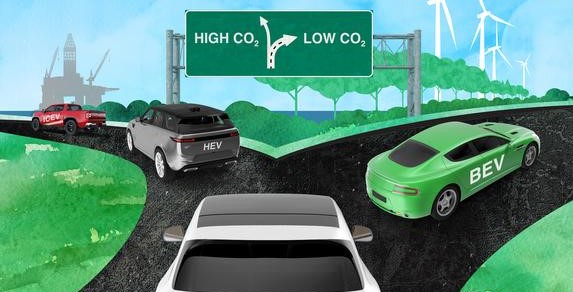
Choosing a more electric vehicle will reduce drivers’ greenhouse gas emissions, regardless of where they live in the contiguous United States, according to a new study from the University of Michigan.
The analysis is the most comprehensive to date, the authors said, providing drivers with estimates of emissions per mile across 35 different combinations of vehicle classes and propulsion systems. This included conventional gasoline pickups, hybrid SUVs and fully electric sedans, with dozens of other permutations.
In fact, the team created a free online calculator that lets drivers estimate greenhouse gas emissions based on what they drive, how they drive and where they live.
The work, published in Environmental Science & Technology, was supported by the Michigan Department of Labor and Economic Opportunity and the University of Michigan’s Center for Electric Vehicles.
“Electrification of vehicles is a key strategy for climate action. Transportation accounts for 28% of greenhouse gas emissions, and we need to reduce them to limit future climate impacts, such as floods, wildfires and droughts, which are increasing in intensity and frequency,” says Greg Keoleian, senior author of the new study and professor at the University of Michigan’s School for Environment and Sustainability (SEAS).
“Our objective here was to assess cradle-to-grave greenhouse gas reductions from vehicle electrification compared with a gasoline-powered baseline,” he adds.
In addition to helping drivers understand their emissions, Keoleian and his colleagues say the information will be valuable to the auto industry and policymakers.
Although electric vehicles are facing policy hurdles at the federal level, the industry remains committed to electrification, Keoleian said. For example, Ford Motor Co. recently announced plans for a more affordable electric-vehicle platform, what it described as a “Model T moment” for the company.
“The government is pulling back on incentives, such as the electric vehicle tax credit, but original equipment manufacturers are heavily invested and focused on technology and affordability of electric vehicles,” says Keoleian, who is also co-director of the U-M Center for Sustainable Systems, or CSS. “Electric vehicles are becoming the dominant propulsion system in other parts of the world and manufacturers recognize that this is the future for the U.S.,” he adds.
A High-Level Life-Cycle Analysis
In their cradle-to-grave analysis, Keoleian and colleagues studied emissions figures not only from driving the vehicles but also from their manufacturing and disposal. In doing so, they considered a range of factors: engines, vehicle class, driving behavior and location.
The engines included conventional internal combustion engines, electric hybrids, plug-in hybrids and fully electric or battery-electric vehicles. Vehicles with these propulsion systems are abbreviated as ICEV, HEV, PHEV and BEV, respectively. For vehicle class, they considered pickups, sedans and sport utility vehicles (they considered “generic” versions of these vehicles produced in 2025, which are representative of new vehicles on the market).
Driving behavior included familiar factors like highway versus city driving, but also modern considerations, such as vehicle location and how often PHEV drivers drove on battery power versus gasoline.
Location affects emissions in two ways, Keoleian said. First, all vehicles—especially BEVs and PHEVs—consume more energy in colder temperatures and have lower range in cold locations. Second, electricity-grid emissions vary by location, so charging electric vehicles in a county with a cleaner grid would emit fewer greenhouse gases.
By addressing all these variables in a single study, the researchers were able to compare emissions of different vehicles on an equivalent basis. This allows for a detailed comparison, for example, between a gasoline pickup in Perry County, Pennsylvania, and a fully electric compact sedan in San Juan County, New Mexico.
In addition to these detailed comparisons, the work also yielded important takeaways about the overall landscape. The study showed for the first time that BEVs have lower life-cycle emissions than any other vehicle type in every county in the contiguous United States. On average, internal-combustion pickup trucks were the highest emitters, at 486 grams of CO2 equivalent per mile. Switching to a hybrid pickup would reduce this by 23%, while a fully electric pickup would represent a 75% drop.
Another interesting statistic came from the team’s analysis of how emissions changed as a pickup carried weight. A BEV pickup carrying 2,500 pounds still emitted less than 30% of what an unladen ICE pickup did.
Overall, electric compact sedans had the lowest emissions, at just 81 grams of CO2 equivalent per mile—less than 20% of the per-mile emissions of a gasoline-powered pickup. The vehicle class with the lowest emissions was electric compact sedans with the smallest range, 200 miles. Emissions associated with battery production for longer-range vehicles increased their life-cycle greenhouse gas contributions.
This also highlights another major conclusion of the study, Keoleian says. In addition to electrifying your vehicle, choosing the smaller vehicle that fits your needs will also reduce emissions.
“The key is really matching your vehicle to your needs,” he explains. “Obviously, if you work in a trade, you may need a pickup. But you could buy a battery-electric van. If you commute alone to work, I’d recommend a BEV sedan,” he concludes.
With the team’s online calculator, people interested in vehicle emissions can get personalized answers for their situations. The research is open access and freely available.