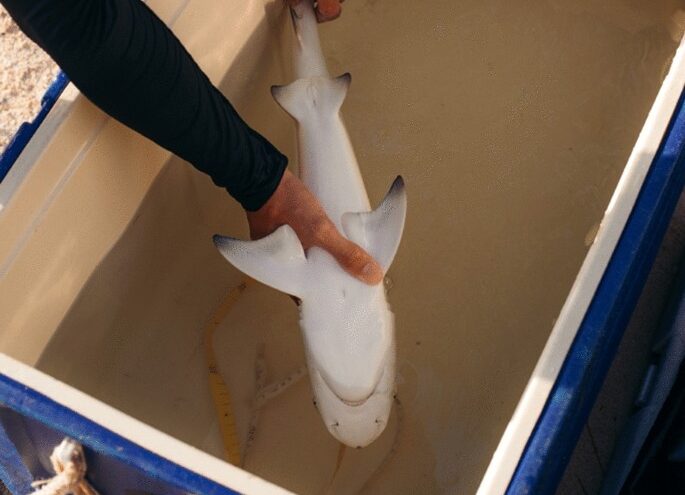
Many will surely know that some sharks and rays, when turned over onto their horizontal axis, enter a state of total immobility. This physiological phenomenon is called tonic immobility, which is thought to be a survival strategy that allows the animals to pretend they are dead and, thus, become less attractive to potential predators.
But is this “trick” still useful to them? A pair of scientists from James Cook University in Australia set out to seek an answer to this question and concluded that it no longer is.
The investigation was based on the study of 13 species of sharks, rays and chimaeras, all cartilaginous fishes in the class Chondrichthyes, and all living in aquariums, with the exception of two Pacific sharpnose sharks (Rhizoprionodon longurio), which were studied in the sea in a wild context.
Of all these species, four demonstrated tonic immobility when turned onto their backs, and the researchers argue that this capacity is a remnant of distant times that helped the animals escape predators, but that it serves no real purpose today.
“We need more data to reach definitive conclusions, but our theory is that tonic immobility persisted in these species simply because it was not very harmful, even if it provides no real benefit for survival,” says, in a press release, Joel Gayford, the first author of the article published in the journal ‘Reviews in Fish Biology and Fisheries’.
By reconstructing the phylogenetic tree of the species that do not exhibit tonic immobility, the researchers say that, at some point in the last 200 million years, they must have possessed this ability.
For species that adapted to foraging in crevices in rocks, for example, losing the ability for tonic immobility may indeed have been beneficial. When foraging in tight spaces, where they often have to wriggle their bodies to reach prey and end up on their backs, sharks would enter tonic immobility and would be dangerously vulnerable to predation.
Today, orcas, for example, have learned to take advantage of sharks’ tonic immobility by turning them over, paralyzing them, and feeding on their livers. Therefore, although it may have been useful in ancient times, it seems, in some cases, to have become a disadvantage.
“A tonic immobility is not necessarily a smart survival strategy,” says Jodie Rummer, coauthor of the study, who argues that this capacity may be nothing more than evolutionary junk that may even disappear completely.