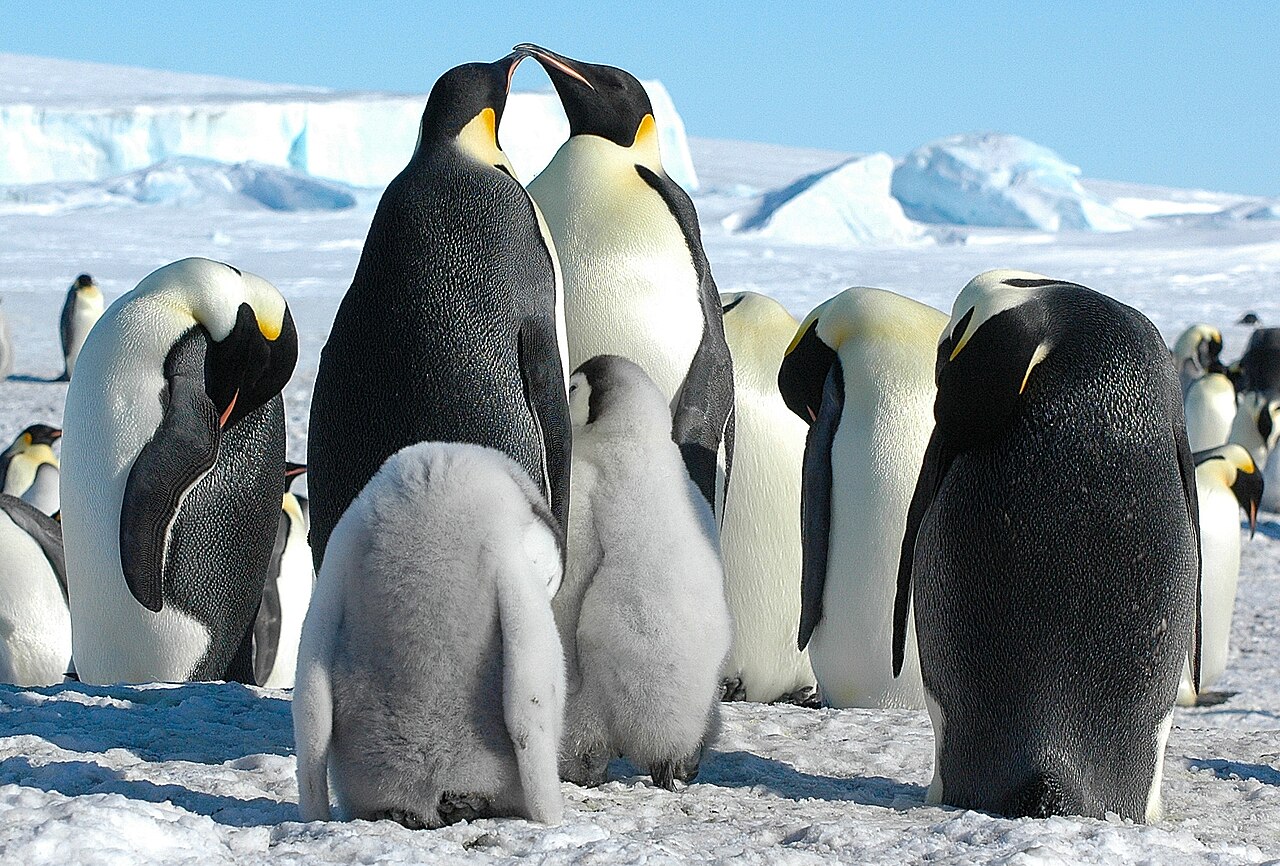
Coulman Island, in the Ross Sea and about ten kilometres from the Antarctic coast, is considered one of the world’s largest colonies of emperor penguins (Aptenodytes forsteri). But in the most recent breeding season something troubling happened.
The number of chicks that hatched between June 2025 and January this year was 69% lower than in the previous breeding season. In an article published in the journal Communications Earth & Environment, a group of researchers from the Korea Polar Research Institute (KOPRI) reveals that a large iceberg detached from the Antarctic mainland, approached the island, and blocked the colony’s access to its feeding areas.
The scientists say this shows that it is not only the coverage of sea ice (essential for penguins and other animals to rest, reproduce, and feed) that affects reproductive success. Large-scale iceberg movements can also be decisive.
In November and December 2025, the team carried out two aerial surveys of emperor penguins on Coulman Island, counting only 6,658 living chicks.
The iceberg in question was about 13.9 kilometres long and four kilometres wide and is believed to have detached from the continental mass sometime in March 2025.
The researchers estimate that the barrier created by the iceberg will have significantly increased the distance parents had to travel to find food, to sustain themselves and their chicks waiting on the island. In 2024 that distance was about 9.3 kilometres, but in 2025, because of the obstacle, it was already nearly 15 kilometres.
While acknowledging that this work is limited to a single breeding season and that the consequences of iceberg movements can be unpredictable and temporary, the authors of the study say that future investigations into emperor penguin reproduction should take into account the impacts of these events on estimates of longer-term trends, crucial for assessing the conservation status of the species, currently listed as “Endangered” on the IUCN Red List.
The scientists estimate that the global population of emperor penguins has already suffered a 10% loss between 2009 and 2018, and it is predicted that the increasing impacts of climate change in Antarctica, the only region where the species occurs in the wild, will cause a decline that could exceed 50% by the 2080s. The main threat is the loss of sea ice caused by rising temperatures at the Earth’s South Pole.