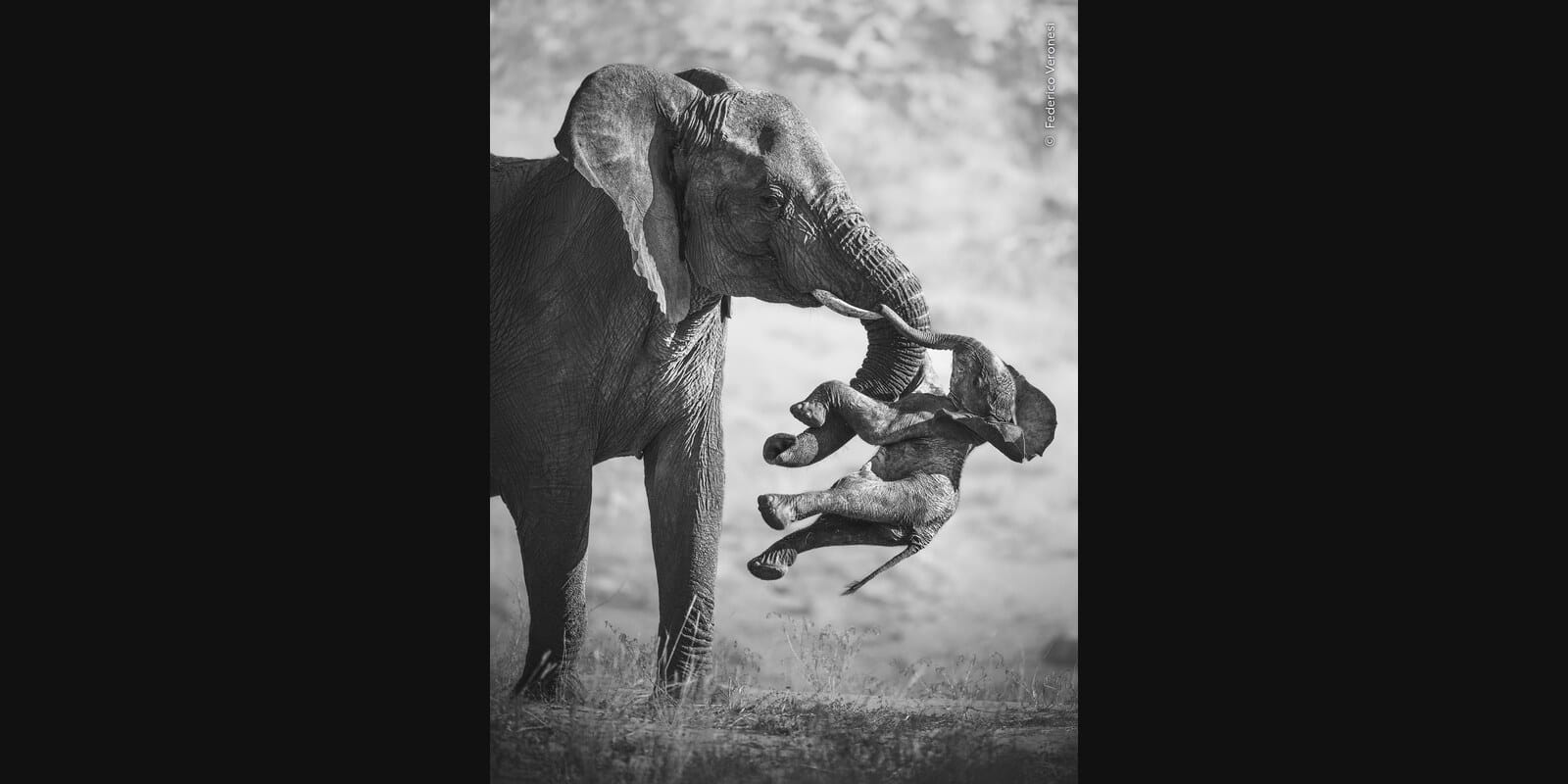
A photograph of an elephant carrying a dead calf, in the Huab River valley in Namibia, is the grand winner of Wildlife Photographer of the Year 2026. The Aftermath, by Italian photographer Federico Veronesi, was chosen from a record-breaking 65,403 images submitted from 121 countries and territories for the 62nd edition of the competition, which is developed and produced by the Natural History Museum in London. The winners were announced on 13 October, and for the first time in 62 years, the two photographs awarded the top prizes, for adults and for young entrants, are in black and white.
Federico Veronesi was following a herd when he noticed an unusual pattern of drag marks in the sand of a dry riverbed. The explanation emerged when he reached the family group: a female appeared with the dead calf, its leg caught between the carcass and the trunk. Death-related behaviours have been observed in Asian and African elephants, from vocalisations and guarding the dead to bone handling and carrying the calves, and there are researchers who see them as a way to understand death, while others interpret them as possible manifestations of mourning. “Emotionally, it is a gut punch, heart-wrenching. Intellectually, it is proof that animals have cognition,” summarizes Kathy Moran, chair of the jury.
The Young Wildlife Photographer of the Year prize went to Oscar Whitfield, a young British photographer living in Zimbabwe, with Labour of Love, an image of a dung beetle pushing a ball of dung. To capture it, he lay on the ground and photographed the insect at eye level, in the dust and heat. There are more than 5,000 dung beetle species in the world and their role is larger than it appears: by breaking up and burying the dung, they prevent the conditions that lead to methane production and help it decompose more quickly, reducing the pests that affect cattle and wildlife.
The winners across 19 categories come from countries such as the United Kingdom, South Africa, India, Colombia, Japan and Poland, in themes that range from urban wildlife to photojournalism, and were chosen anonymously by an international jury of experts in photography, cinema, conservation and science. The winning images have been on display at the Natural History Museum since 16 October and can be viewed until 11 July 2027, before they embark on a tour across the United Kingdom and abroad.
The exhibition also shows the Biodiversity Intactness Index (BII), an indicator created by the museum and adopted in the Global Biodiversity Framework, which measures on a scale from 0 to 100% how much of a region’s natural biodiversity remains, to help visitors understand how the habitats depicted in the photographs are changing.
Photographs: Federico Veronesi / Wildlife Photographer of the Year (spotlight) and Oscar Whitfield / Wildlife Photographer of the Year.