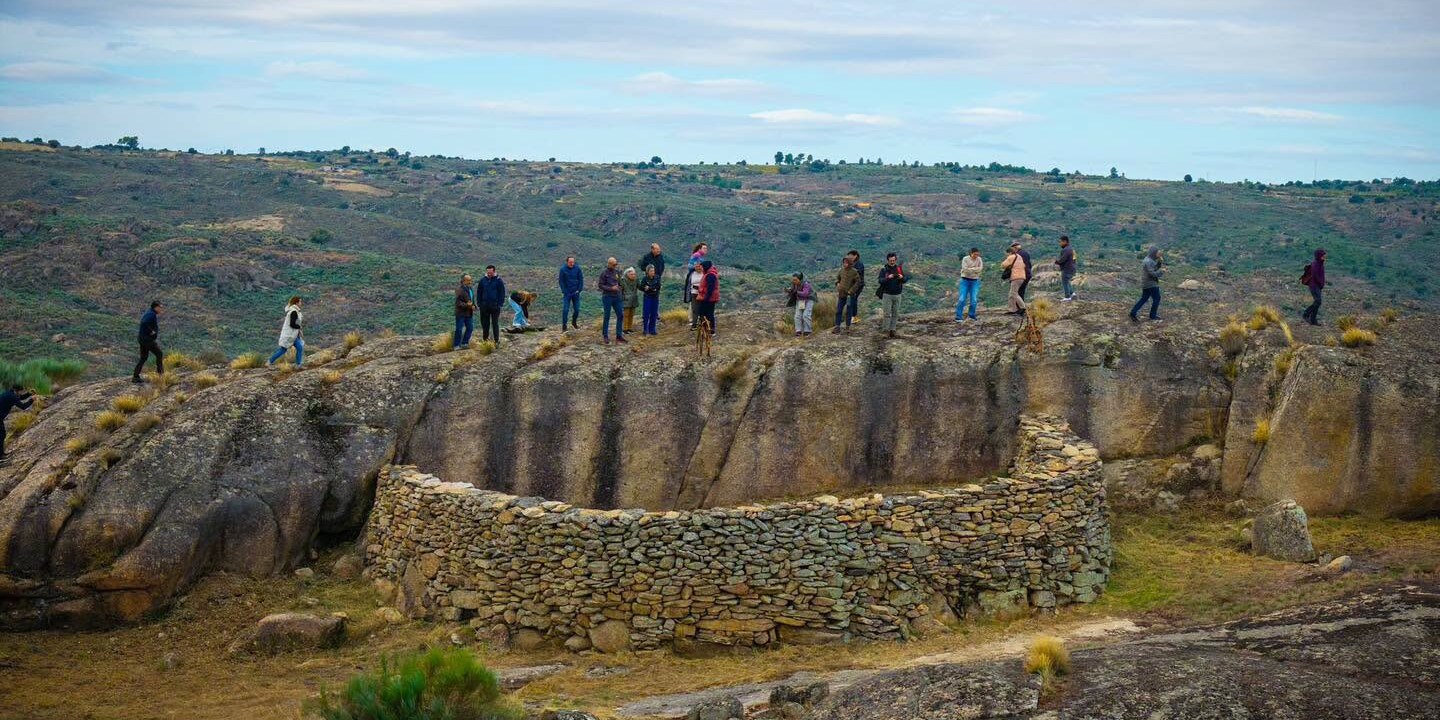
An ancient wolf trap in the Ermo das Águias, in the parish of Alto do Palurdo, municipality of Pinhel, was restored and inaugurated on Sunday, October 18. The intervention was promoted by Rewilding Portugal in partnership with the Municipality of Pinhel and is part of the LIFE LUPI LYNX project, which seeks to create conditions for the recovery of the Iberian wolf and the Iberian lynx south of the Douro River, in Portugal and Spain. The inauguration brought together the Mayor of Pinhel, Daniela Capelo, the executive director of Rewilding Portugal, Pedro Prata, the artist Rui Miragaia, the researcher Francisco Álvares, and members of local communities.
The fojos are ancient traps for capturing wolves, built when protecting livestock was essential to the subsistence of rural communities. The Ermo das Águias fojo belongs to the so-called “fojos de cabrita,” enclosures delineated by stone walls where the wolf was lured with an animal used as bait and from which it could not escape. Its location gives it special value, because the vast majority of known fojos on the Iberian Peninsula are in the northern mountains, such as Peneda and Gerês, and this specimen broadens what is known about the distribution of these structures in the country.
Inside the fojo, a sculptural ensemble by Rui Miragaia was installed, depicting, at life size, wolves hunting an ibex. The work invites viewers to regard the wolf as a predator and as part of ecosystems, and links the memory of the persecution of the species to the need to create conditions for coexistence. “We want those who come here to understand better the role of the wolf in functional ecosystems and to know the solutions that can help protect livestock and make coexistence possible,” says Pedro Prata.
The LIFE LUPI LYNX, coordinated by Rewilding Portugal and cofinanced by the European Union through the LIFE Programme, combines habitat restoration and an increase in wild prey with measures to prevent livestock damage, scientific monitoring, combat against crimes against wildlife, and environmental education. The consortium also includes BIOPOLIS/CIBIO, Grupo Lobo, the University of Aveiro (CESAM) and, on the Spanish side, WWF Spain. Pinhel is the project’s Ambassador Municipality in 2026.
The restoration was accompanied by the creation of a walking trail inside the Ermo das Águias, an area managed by Rewilding Portugal, which allows visitors to reach the fojo and to experience the landscape of the Great Valley of the Côa. The organization promises regular guided visits to the fojo and to the artistic intervention in the near future.