Sometimes, when dolphins and whales appear in behaviors considered to be “play,” both groups of animals are active participants in the interaction. But not always.
A pair of scientists from Griffith University, in Australia, analyzed hundreds of videos and photographs captured by tour operators, other researchers or members of the general public to try to unravel what they describe as “a rarely studied behavior.” That is, they wanted to understand whether when dolphins and baleen whales (mysticetes, or toothless whales) appear together in what seem to be playful social interactions, both participate in them or whether it is just a unilateral and unreciprocated occurrence.
The data studied span 19 different species (between dolphins and whales) and 199 separate and unrelated interactions that occurred in 17 different locations worldwide. The researchers mainly aimed to understand how the baleen whales reacted to the surrounding dolphins, since among experts it is common to consider that delphinids sometimes harass and irritate their larger relatives.
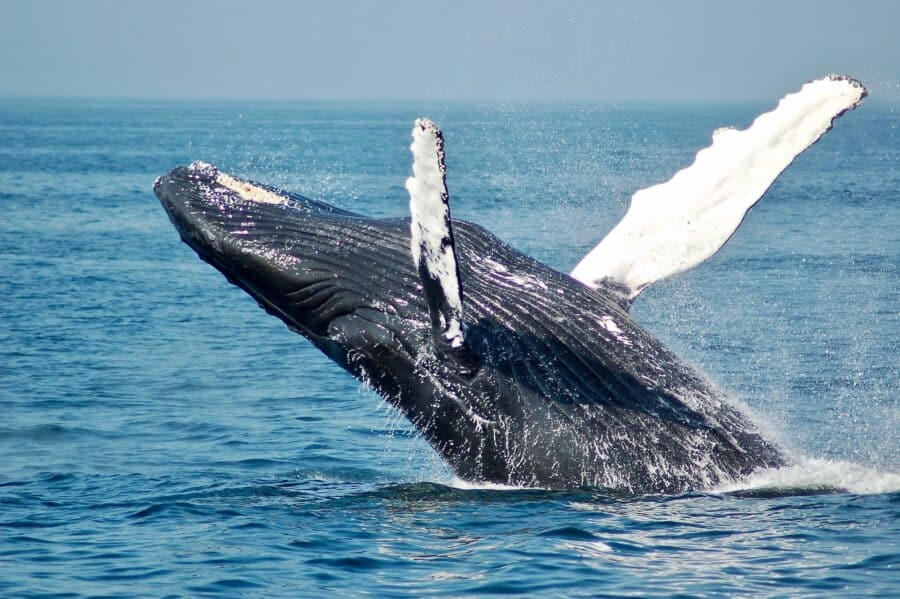
In an article published in the journal “Discover Animals, Jan-Olaf Meynecke and Olivia Crawley say that a quarter of the interactions analyzed can be defined as “mutual interaction.” And this is even more significant with regard to humpback whales (Megaptera novaeangliae).
“We found that for one third of the events the behavioral responses [of the humpback whales] to the dolphins around them appear positive,” Meynecke said in a press release.
“The humpback whales rolled from side to side, exposing their bellies and other behaviors associated with courtship or friendly socialization,” he adds. It is considered that this mysticete species is prone to what the study authors describe as “inter-specific altruism, showing affinity for other species.”
Of the nearly two hundred recorded interactions, the most common involved dolphins swimming near the whales’ snouts, which the scientists say may be a way for the first to take advantage of the current created by the second to move more energetically efficiently and as an expression of unilateral play. In some interactions, the dolphins even touched the whales’ snouts with their tail flukes.

The researchers say that studying the behavior of marine mammals is important to understand “their complex social structures,” as well as to deepen knowledge about marine ecosystems and how different species interact with one another.