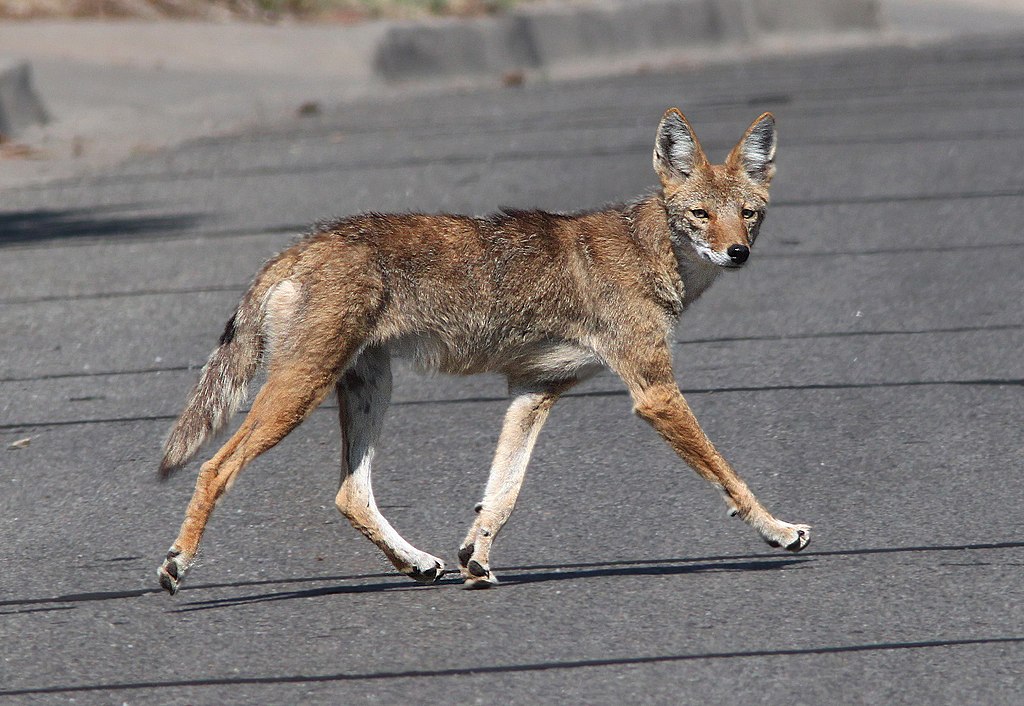
Evolution is regarded as a slow process, whose effects will only become visible after many, many years. Yet some cases challenge this notion. The coyote (Canis latrans) is one of them.
With the expansion of human presence and their urbanized areas, several animal species are swapping rural contexts for cities. One of them is the coyote, an iconic wild canid of North America’s urban fauna.
To live and roam in urban environments, animals must rapidly adapt to the new surroundings, from the kinds of foods they can find to the survival strategies that allow them to escape the risks of living in close proximity to humans.
A trio of American researchers aims to understand what changes in the coyotes’ genetic map allow them to survive in cities, since, as Elizabeth Carlen, of the University of Washington in Saint Louis and one of the authors of the the article published in the journal Genome Biology and Evolution, says, these animals “are thriving in urban spaces.”
The scientists consider that coyotes, being “a highly adaptable carnivore”, may be the key to understanding how urbanization is altering the genomes of wild animals, transformations that must happen quickly. To achieve this, for example, it is necessary to compare the differences between the genomes of city-dwelling coyotes and rural coyotes.
Although several scientific studies have already documented ecological differences between urban and rural coyotes, and while it is known that there are genetic differences between them, the specific genes or regions of the genome that are affected in this transition have not yet been identified.
In rural settings, coyotes’ diets are based on rabbits and rodents, though other small mammals may be included. However, in cities the food sources are different, ranging from human waste to dog food left on the street.
In a statement, Carlen says this would result in greater intake of glucose and starch. Thus, with the increased intake of sugars, the bodies of coyotes would need to be able to regulate insulin better, something that may be encoded in the genes of urban specimens.
On the other hand, with a diet richer in starch, they also must be able to break down this polysaccharide with greater expression of the genes that produce the enzyme amylase. The genomes of dogs (Canis familiaris) show a large number of copies of a gene known as AMY2B, responsible for amylase production, which increases the efficiency of starch digestion. Something similar may be happening with coyotes.
This study is just the beginning. The objective is to present genes or regions of the genome that could be good candidates for future investigations that want to discover how coyotes have adapted so well to urban environments.
“Although we are witnessing a continual growth in the field of urban evolution, studies linking specific genes to adaptations in urban regions are still relatively scarce,” notes Carlen.