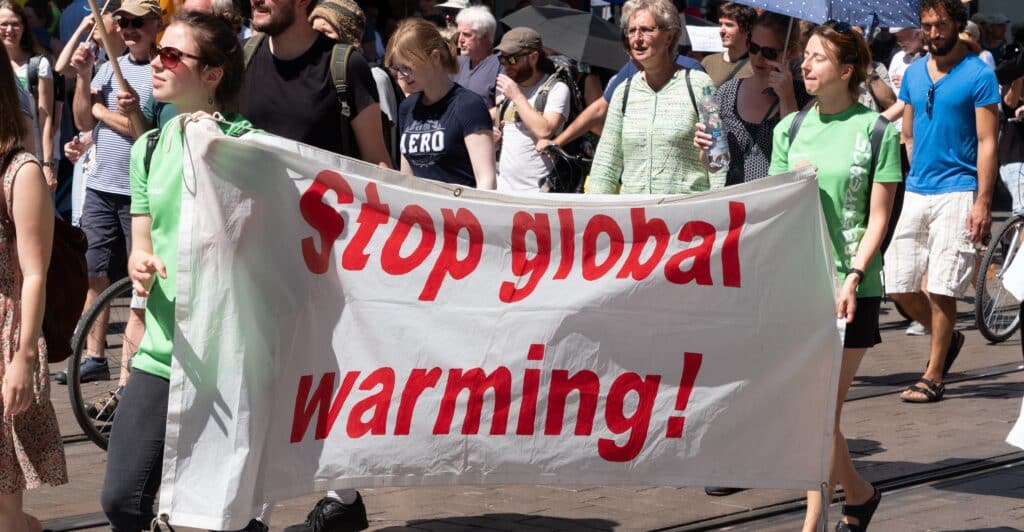
An investigation by Flinders University concludes that the combination of growing concern about climate change, animal welfare, and environmental degradation could contribute to an increase in the more radical forms of protest, especially when citizens feel there is a moral obligation to act.
As the impacts of climate change intensify and the perception of government inaction grows, environmental activism forms may become more frequent and, in some cases, more radical. The conclusion comes from a study led by Flinders University in Australia, which analyzed the relationship between citizens’ moral convictions and their willingness to participate in protest actions.
Published in the scientific journal Environment and Behaviour, the study suggests that people who see environmental protection and animal welfare as an intrinsic value — and not merely as something useful for society — develop a greater sense of moral obligation, which can lead them to participate in both traditional forms of activism and civil disobedience.
“Viewing an environmental or animal-welfare cause as sacred or inherently worthy of protection, rather than merely useful to us, reinforces people’s moral conviction,” says Lucy Bird, a postdoctoral researcher at Flinders University and the study’s first author.
According to the researcher, this conviction becomes even stronger when individuals perceive that others around the world share the same values and goals.
The researchers note that environmental activism now takes multiple forms, from signing petitions and sharing content on social media to acts of civil disobedience and direct protests. Among the recent examples are actions by activists who threw paint on artworks in European museums, invasions of slaughterhouses to remove animals, or protests against mining projects in Australia.
Lucy Bird considers it probable that this type of mobilization will continue to grow if more effective international measures are not adopted to reduce greenhouse gas emissions and respond to the impacts of climate change and biodiversity loss.
The research team emphasizes that many activists justify their actions with the visible effects of the climate crisis, namely the loss of lives and homes due to floods, wildfires, extreme droughts, and other extreme weather events associated with global warming.
Still, the authors warn of the importance of distinguishing between protest and violent extremism. Emma Thomas, professor of Social and Political Psychology at Flinders University, argues that citizens should be able to express their convictions and demand social justice through legitimate forms of protest, without resorting to violence.
“What we need to understand is the commitment of people to a cause and what leads that moral conviction to transform into more radical action,” says the researcher.
The study is based on the responses of more than 580 Australian adults to two distinct scenarios: one related to a controversial mining project in the state of Queensland and another focused on a situation of animal welfare. The analysis concluded that collective identity, the sense of social justice, and the perception of support from other citizens play an important role in the predisposition to participate in different forms of collective action.